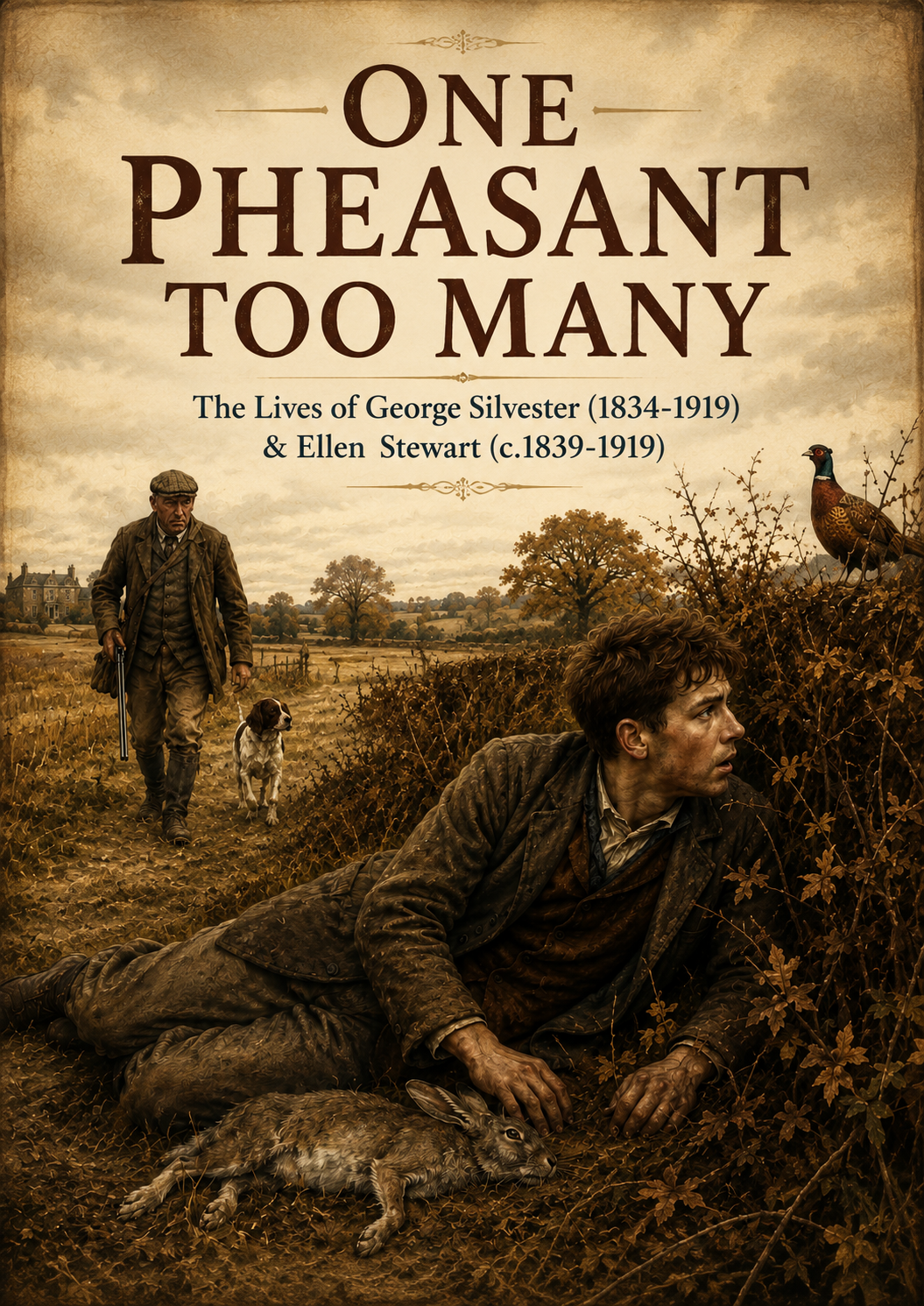
One Pheasant Too Many
& Ellen Menia Stewart (c.1839-1919)
❧
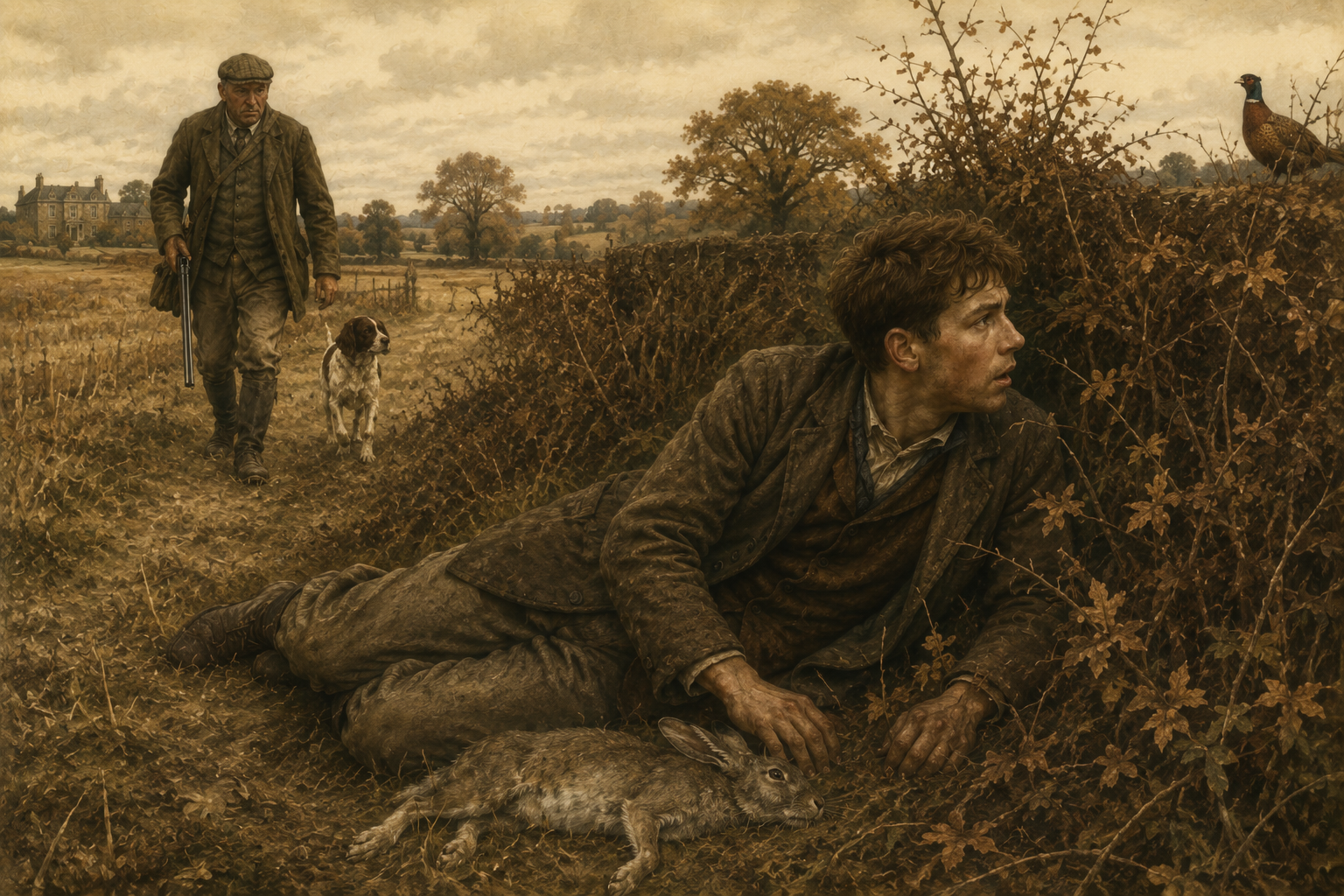
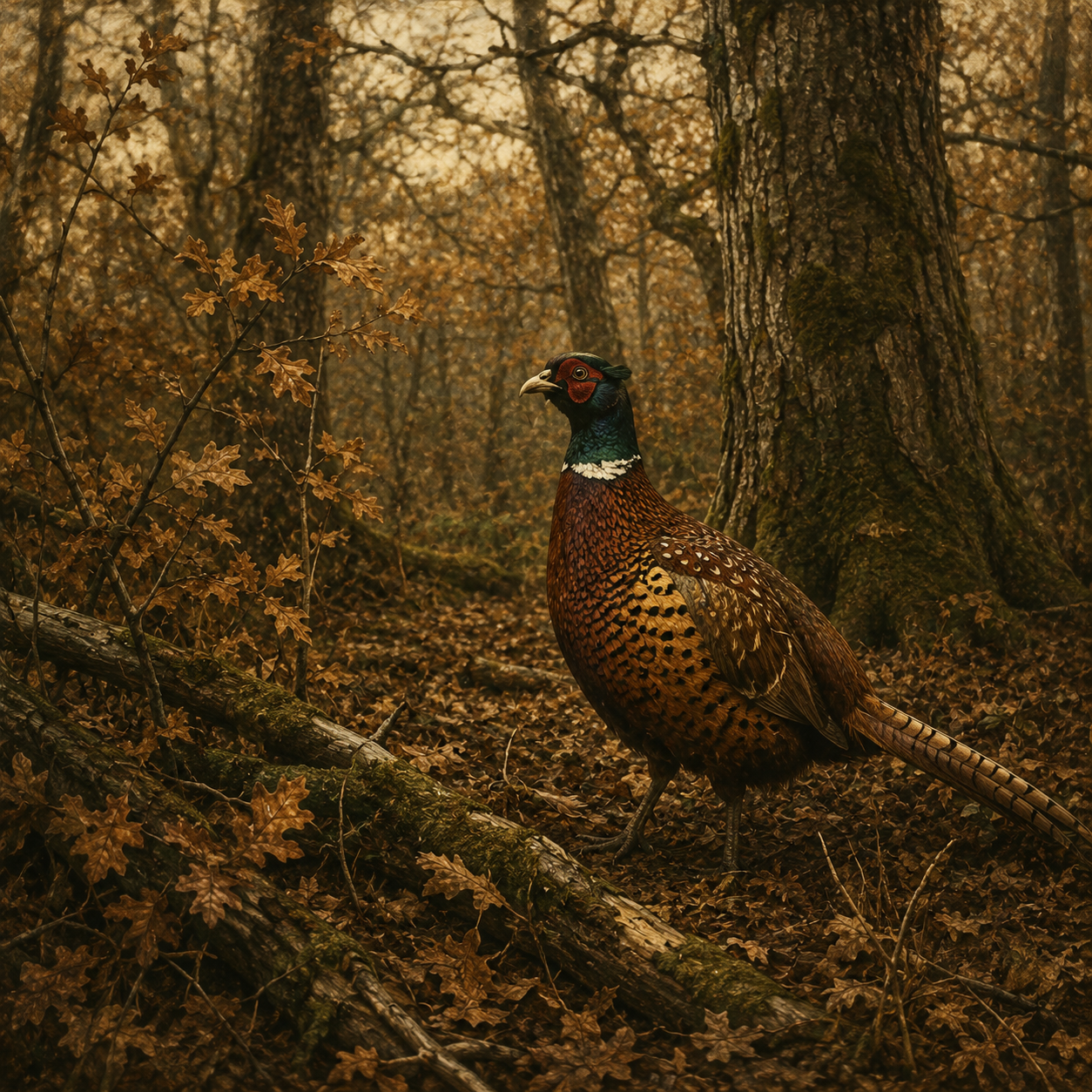
It is the autumn of 1853, in a field on the Idsworth estate, and nineteen-year-old George Silvester is lying face-down in the hedge, not breathing.
The ground is cold and damp through his coat, and there is the smell of wet earth and crushed leaves close under his nose. A rabbit is already stowed against his ribs, still warm, lifted from a snare an hour back. Now a cock pheasant is stepping towards him across the cut stubble, slow and unbothered, its head bobbing, not ten feet off. One more pace. He counts it in his head and holds himself dead still.
He never hears the keeper. The first he knows of it is a fist twisting into his collar and hauling him up out of the hedge onto his feet, his boots skidding in the mud.
It is Daniel Barrett, the gamekeeper, a shotgun broken open over one arm. He has watched these hedges for weeks, and he knows this boy by name.
"Up you get, my lad." Barrett does not even sound angry; he has done this before. "Your father will not be pleased. And on Mr Jervoise's land, too."
George says nothing. The rabbit is still warm against his side; the pheasant is gone into the trees. He already knows how the rest of it goes: a morning in the courthouse at Petersfield, fines the family cannot spare, and the look on his father's face when the news walks home ahead of him.
It is not the first time. This time, though, it will be one pheasant too many.
❧
Introduction
This is the story of George Silvester and Ellen Stewart. He was the son of a Hampshire farm worker. She was a young woman who most likely came from Ireland. They married in Sydney in 1855 and raised nine children over sixty years in Newtown. We have told it from the records that survive, and from the history around them.
A note on the story. We cannot know everything that happened in these two lives. But with careful research, a bit of history, and the records that have lasted, we can work out the shape of the story - and this one is theirs. Where the evidence is solid, we say so. Where it is not, we say that too. Family memory is named as memory. Two things in particular are likely rather than proven: that George left England to get out of trouble, not to chase gold; and that Ellen came from Ireland. The pictures are an artist's idea of how things may have looked, not real photographs - no photograph of George or Ellen is known to survive. We have made nothing up.
Chapter One · to 1850
A boy on the estate
George Silvester was baptised at Holy Trinity church in Blendworth, Hampshire, on 22 November 1834. His father, James Silvester, was a farm labourer; his mother was Harriet.1 George was born into the oldest kind of English life - a working family on a great estate, in a quiet fold of the Hampshire chalk.
The Silvesters had lived in this corner of Hampshire for a long time. Family research traces them back through the farms around Froxfield, Priors Dean and Hawkley - old fields and woods that are still farmed today - to a Richard Sylvester born in the middle 1600s. The land passed from father to eldest son, as land did, until a younger son had to move on.2 By George's father's day the family had come to Blendworth, on the edge of the Idsworth estate.
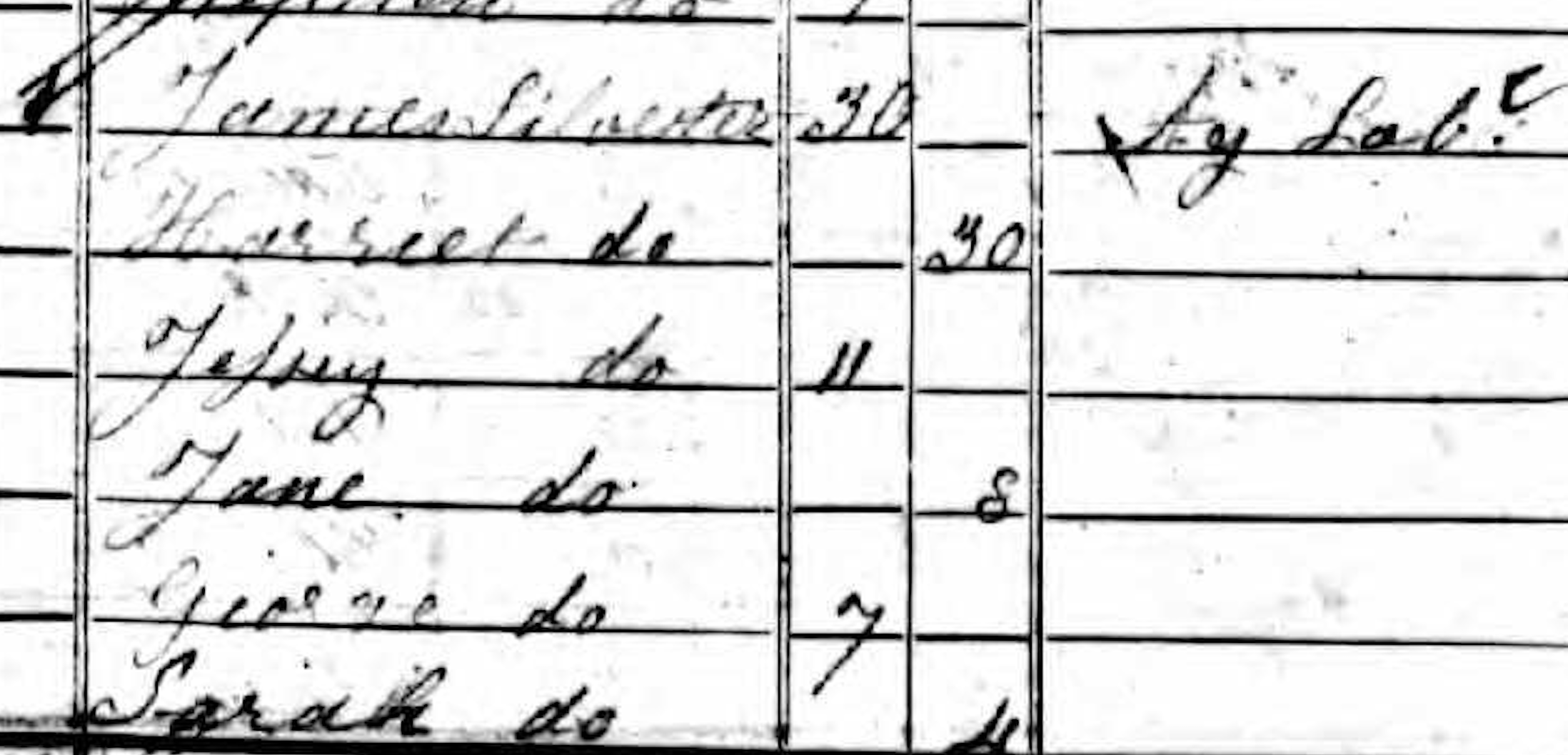
In 1841, when George was seven, the census found the whole family at home: James and Harriet, both about thirty, with Jessey, Jane, George, Sarah and baby Henry.3 It was a full cottage and a thin living. A Hampshire farm worker in those years earned about nine to twelve shillings a week. For a family that size, that was barely enough, and the work dried up in winter.4
Above them all stood the big house. The Clarke-Jervoise family had owned the manor of Idsworth, with its land at Idsworth, Chalton and Blendworth, since 1789, and the new Idsworth House went up during George's boyhood.5 The estate was the whole world. It owned the fields, the cottages, and the game in the woods, and it set the terms on which a family like the Silvesters lived.
George was born into a county with a raw and recent memory. Only four years before, in the hungry autumn of 1830, the farm labourers of southern England had risen in what became known as the "Swing" riots - a revolt against starvation wages and, above all, against the new threshing machines that were taking the paid winter work, once done by hand with a flail, out of poor men's hands. It came close to home: labourers smashed machines and burned ricks across Hampshire, including at Havant and Emsworth only a few miles from Blendworth, before the state crushed the rising with hangings and transportations to Australia. That was the world George grew up in - machines eating the old work, wages that would not stretch, and a law that came down hard on labouring men who stepped out of line. It is worth holding on to, because much of what follows - the poaching, and in the end the leaving - is the story of a man born on the wrong side of exactly that bargain.36
A Hampshire farm worker's life
The work followed the year: ploughing and sowing, hay in summer, the long push of harvest, and carting through the wet months. Pay of nine to twelve shillings a week left almost nothing over.4 Winter was the hungry time, once machines took over the threshing that had once filled the cold months. This was the world George was born into - and the poverty that made a rabbit or a pheasant from the squire's woods look less like a crime and more like supper.
The estate world: Pyle Farm, Richard Gale and the Jervoises
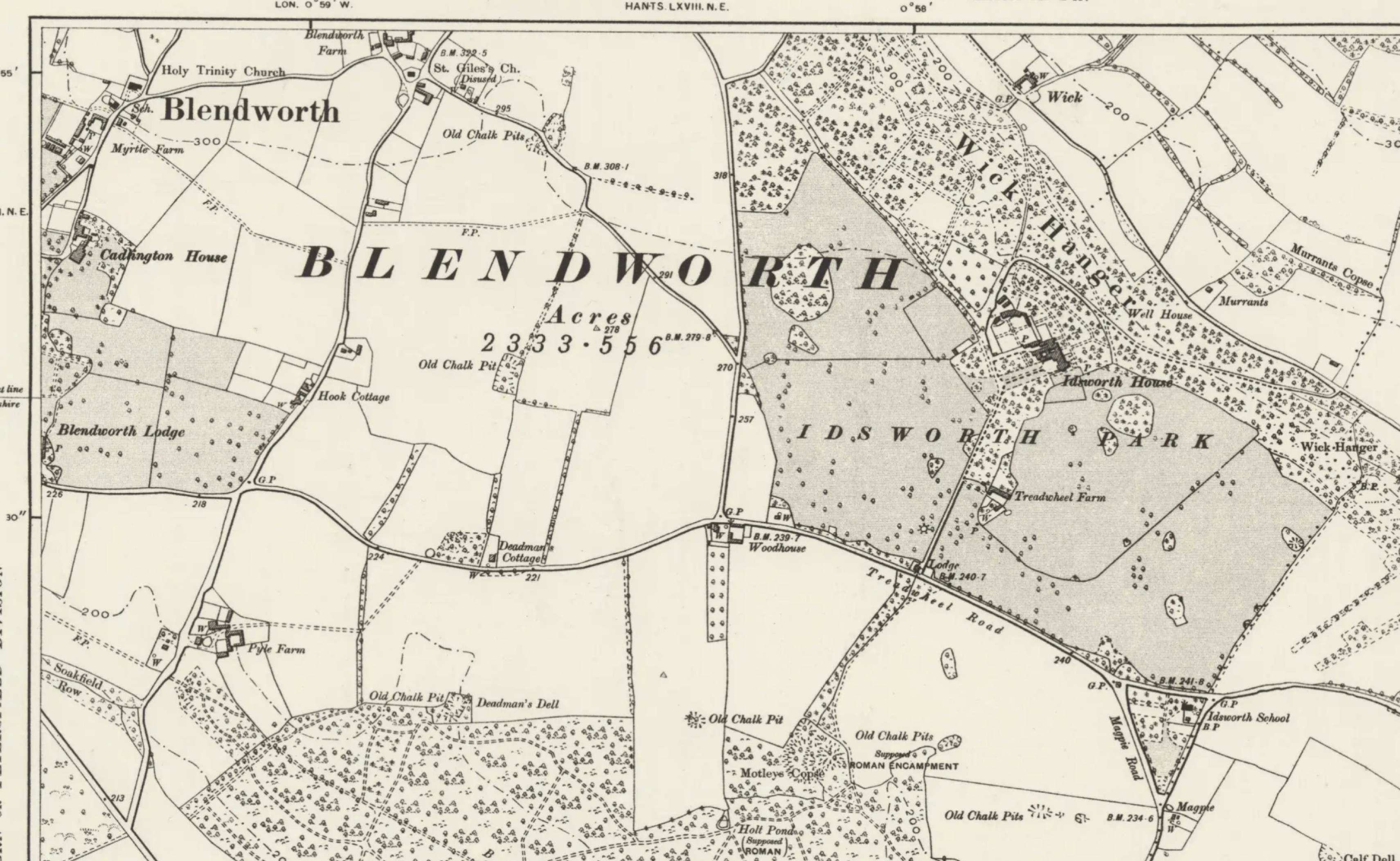
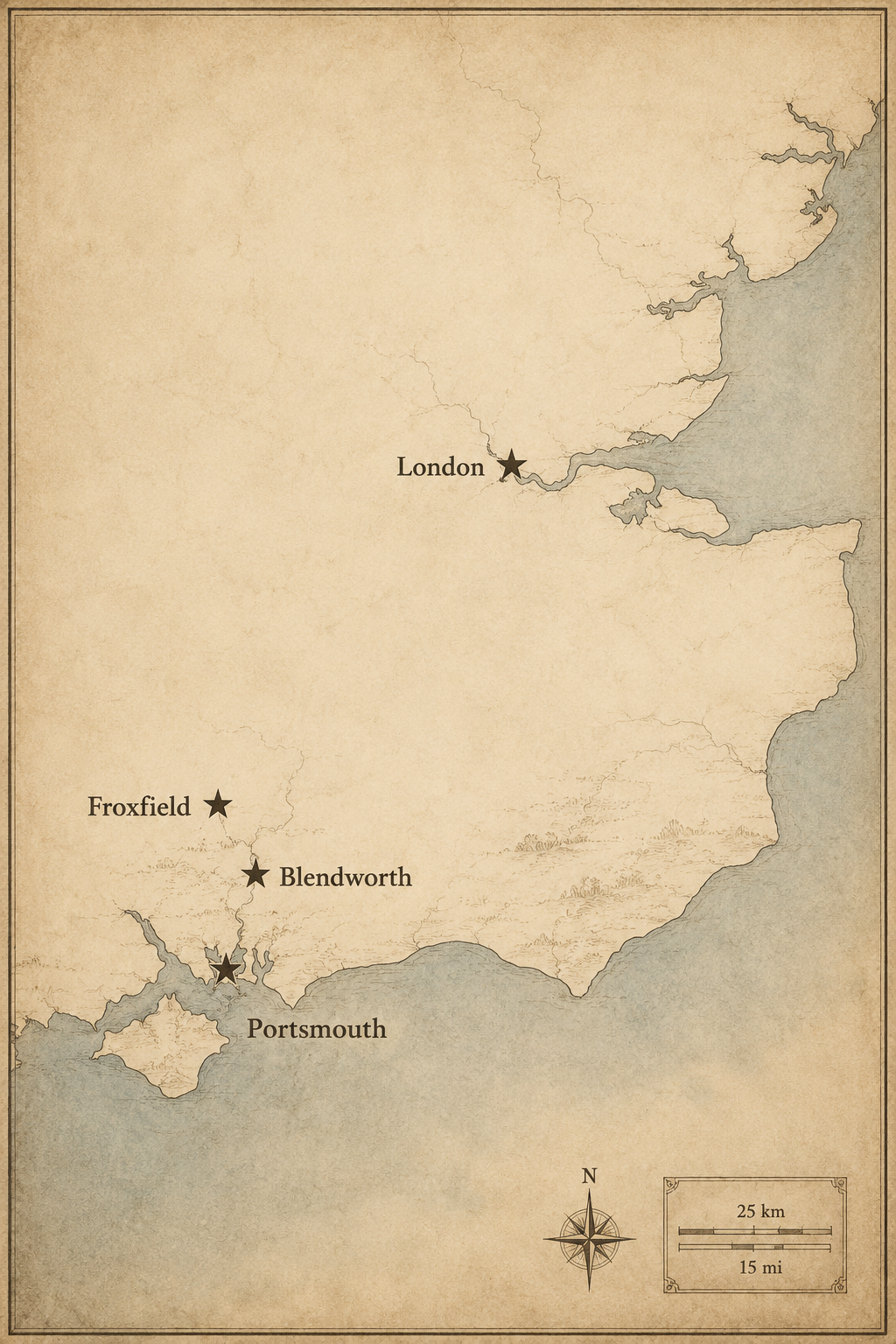
George grew up inside a small, tight world held together by the estate. At the top were the Clarke-Jervoise baronets of Idsworth. Below them came the tenant farmers, and below them the labourers in their cottages. George's father worked at Pyle Farm for its farmer, Richard Gale, for about forty years - long enough to be part of the place.6 An 1878 map shows it all within a short walk: Blendworth and its church, Pyle Farm, Deadman's Cottage, and across the lane Idsworth House and its park.7 Everyone knew everyone, and everyone knew their place.
Chapter Two · 1851-1853
Before the squire's bench
❧
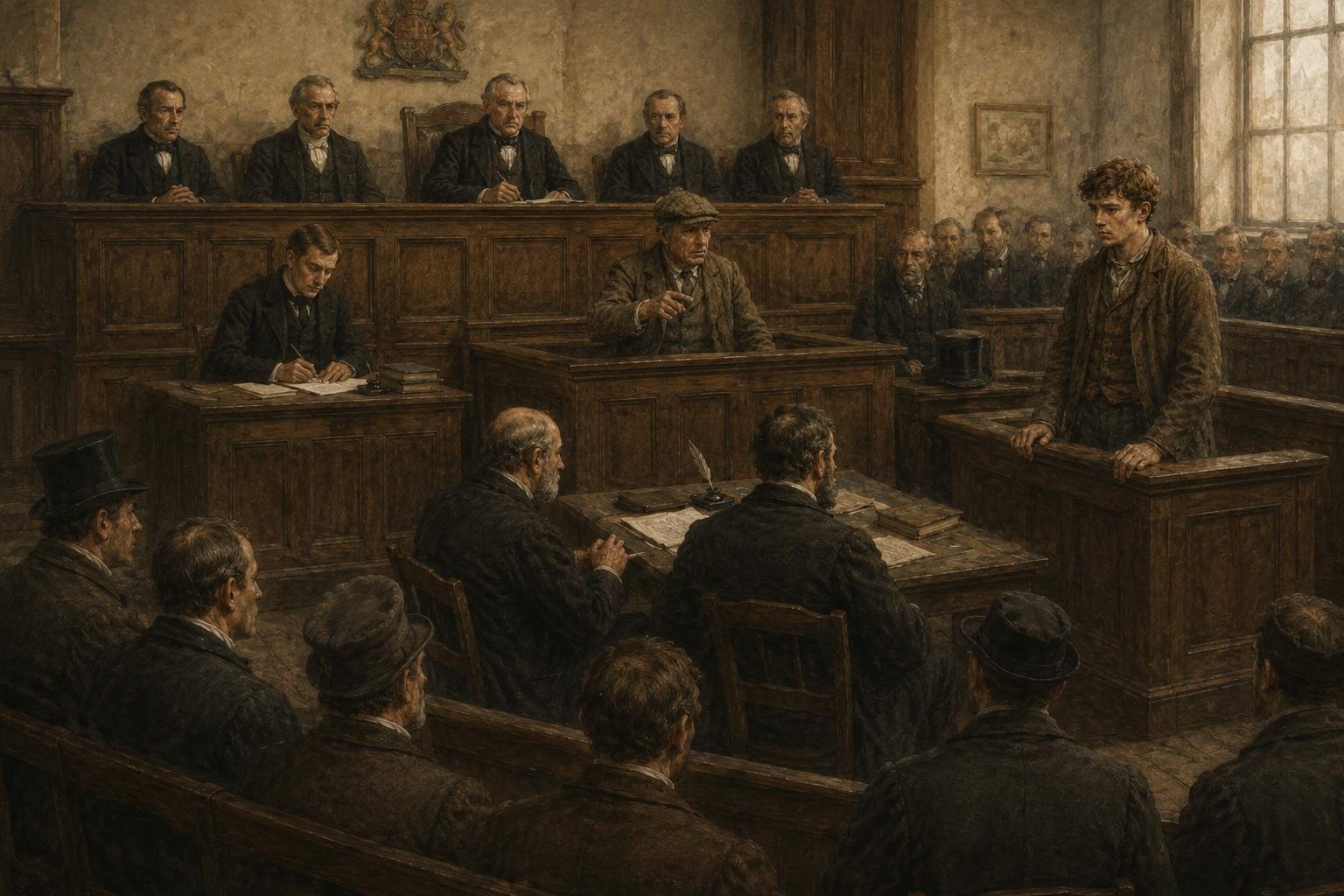
It is Tuesday, 12 April 1853, in the town hall at Petersfield, and George is standing in the dock with his cap in his hands.
The room is close and full - labourers along the back wall, a smell of damp wool and pipe smoke hanging under the beams. At the bench sits Sir Jervoise Jervoise himself, the man who owns the land George was taken on, with three other gentlemen beside him.
The keeper, Daniel Barrett, stands and gives his evidence flat and unhurried. "In the hedge, your worships. A rabbit on him already, and reaching for the bird." And it is not the only charge; a second one, from an earlier day, is read against him at the same sitting.
George is a little cheeky about it at first, the way a young man is when he thinks he has nothing left to lose - a half-smile, a small shrug.
Then he catches his father's eye, at the side of the room, and the smile dies.
James Silvester says nothing at all. He does not need to. Forty years that man has worked at Pyle Farm with a clean name, never once going to the parish, and here is his son in the dock of the very squire they both depend on. The look on his face is not anger. It is heavier than that. He has had enough.
The clerk reads out the penalties: thirty shillings on the keeper's charge, ten and six on the older one, and costs on both - more than two pounds all told, close to a month's wages, and far more than George has ever held in his hand. He barely hears the figures. He is watching his father turn and walk out into the street, and he is beginning to understand two things at once: that money he cannot find will have to be found from somewhere - and that there may soon be no room for him here at all.
❧
A boy who grows up hungry, on land full of game he is not allowed to touch, learns early where the line is and how to cross it. By his late teens George Silvester was crossing it often enough to be caught.
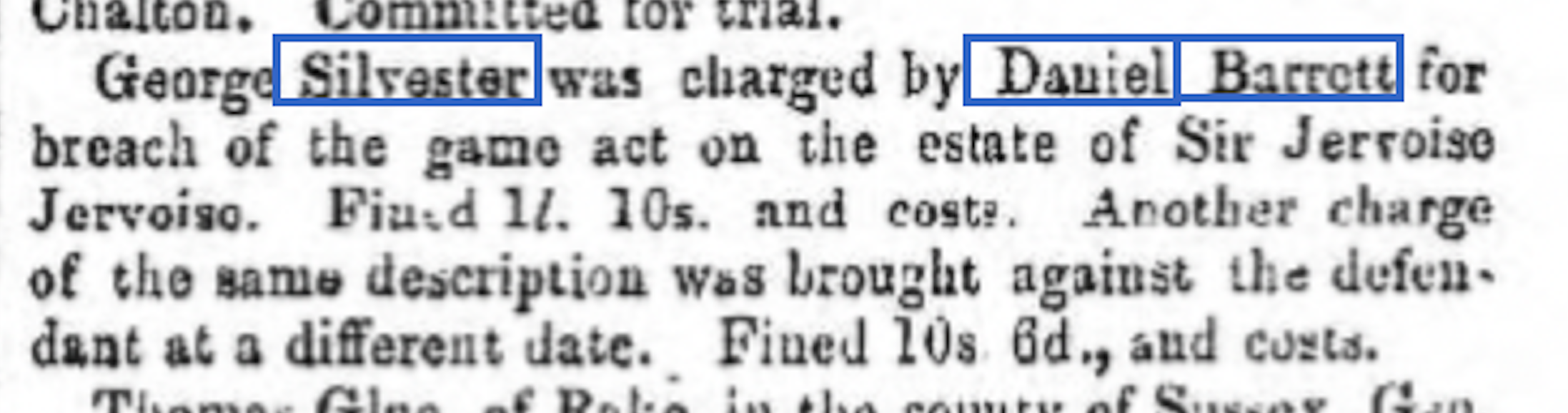
The court records are plain. In December 1851 he was sent to the Hampshire county prison for two months for breaking the game laws.8 In March 1852 he was back, sent down for a month on the same kind of charge.9 Then came the Petersfield petty sessions of 12 April 1853, with Sir Jervoise Jervoise on the bench - the second baronet, the very man whose fields his family worked. That day George answered not one charge but two: the keeper Daniel Barrett's, for poaching on the Jervoise estate, and a second from an earlier day. He was fined on both - one pound ten shillings on the first and ten shillings and sixpence on the second, with costs on top, more than two pounds in all.10
That was a crushing sum for a farm-labouring family on nine to twelve shillings a week - close to a month's wages, and well beyond anything George could pay himself. The game laws were unforgiving here too: a man who could not pay his fine was sent to prison instead. So the money had to come from somewhere. Either George served more time in default, or the family found it - and the likeliest hand is his father's, James, who had kept a clean name at Pyle Farm for forty years and had never once gone to the parish for help. The records do not say which; but either way, the cost of George's poaching had landed, in the end, on the family around him - and most likely on his father.
It would be easy to make George a villain or a rebel. He was probably neither. He was a poor young man taking what the hedges offered, in a county where poaching was the commonest crime of all, and where the game laws came down hardest on men exactly like him.
The game laws and the poacher
By the middle of the 1800s, England's game laws were strict and firmly on the side of the landowner. Day-poaching - trespassing to catch game - was the most common country crime, and most of those convicted were farm labourers, often pleading hardship. The punishment ran from fines to prison with hard labour for those who could not pay.11 George's four convictions in three years fit the pattern: not a hardened criminal, just a hungry young man on the wrong side of the squire's law.
There was one thing in George's favour, though it cannot have felt like it at the time. A generation earlier, a young man in his sort of trouble might have been shipped to New South Wales in chains. Tens of thousands of convicts had been sent that way. But transportation to New South Wales had ended in 1840.12 By George's day the convict ships were finished, and the only way to Australia was to choose it - to go as a free man, and pay your own way. Four convictions in three years is a young man heading somewhere. As it turned out, he was heading to the other side of the world.
Chapter Three · 1853-1856
Getting out
Sometime between 1853 and 1855, George Silvester left England for good. We have not found a passenger record for him - not yet, at least - and that absence is part of the story.
The simplest reading is probably the right one. Here was a young labourer who had been before the bench once too often, on the estate where his own family lived and worked, with a prison record and a name the keepers knew. New South Wales offered the one thing Hampshire could not: a fresh start. The gold rush of the 1850s happened to be on, which filled the ships and made the trip easier. But for George it reads more as the moment and the means than the reason. He was getting out.
The New South Wales he was sailing toward was young, raw and rising. Gold had nearly doubled the colony's population in a single decade - from about two hundred thousand in 1851 to over three hundred and fifty thousand by 1861 - and filled it with young British and Irish arrivals. For a man like George the promise was plain, and as it turned out real: colonial wages ran several times a Hampshire labourer's, and a poor man who could never have owned an acre at home might here come to own a house.13
He was far from alone. Between 1851 and 1860 about three hundred thousand people left England and Wales for the Australian colonies, with a hundred thousand more from Scotland and over eighty thousand from Ireland. Most were young.13 Many travelled "assisted", with their fare paid and their names neatly written down. Many others, especially those paying their own way below decks, slipped out leaving barely a trace.12 That we have no record for George - for now - is exactly what we would expect for a man who paid his own way. Whatever ship he took, the voyage was the same hard journey for everyone: months in cramped quarters, halfway around the world, to a place he had never seen.
What is certain is that he arrived. On 15 October 1855 he was in Sydney, at the Scots Church, to be married.15
❧
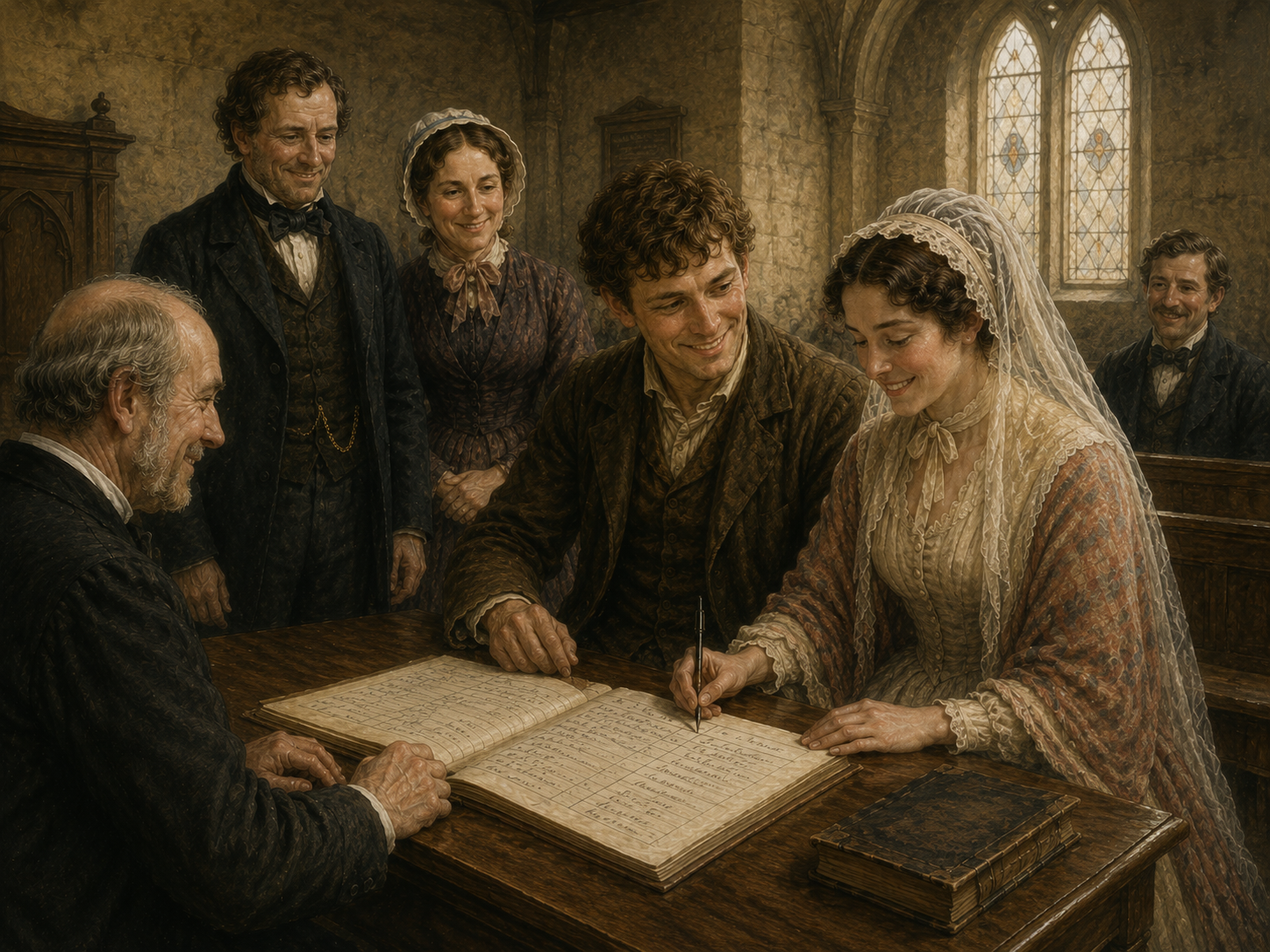
It is 15 October 1855, in the Scots Church in Pitt Street, Sydney, and George Silvester is watching a pen being dipped in ink.
He is a long way from a Hampshire hedge. Two years ago he stood in the dock at Petersfield; now he is in a Presbyterian church at the bottom of the world, in his good coat, beside the young woman he means to marry - Ellen Stewart, a spinster of Redfern, most likely out of Ireland. Neither of them has any people here. That is part of what has drawn them together.
The minister, Dr James Fullerton, reads the words and they answer them. Then he turns the register towards George and holds out the pen.
George takes it. He cannot write his name - he never learned - so he does what he has always done and sets down a plain cross where the name should go. Then Ellen takes the pen and does the same. Two crosses, side by side. Fullerton writes their names in above the marks in a clear, educated hand, and their friends James and Ellen Stoddart step up to witness - and make their marks too.
George is twenty-one. He has a wife, no money, no trade but his own two hands, and a whole strange country in front of him. He cannot read a word of the paper that has just joined them. But he can begin again here, which is more than Hampshire ever offered him - and one day, he tells himself, he will learn to sign his own name.
❧
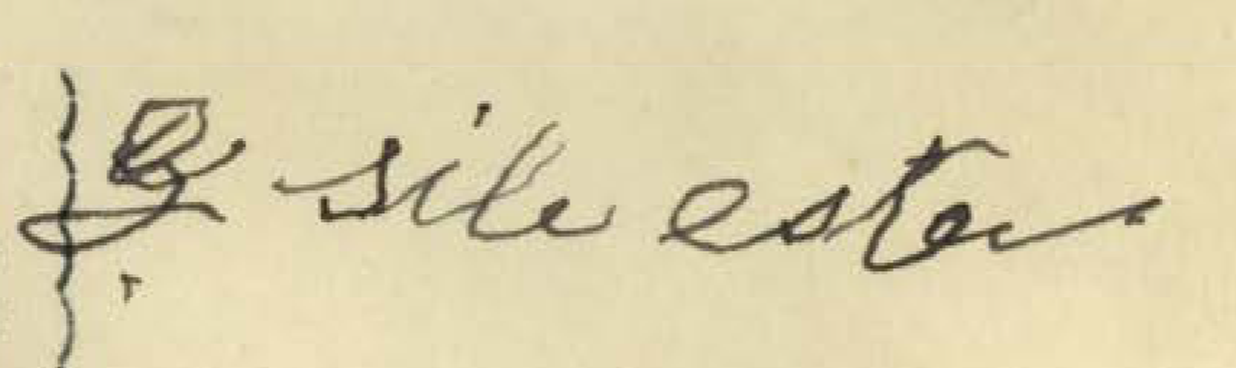
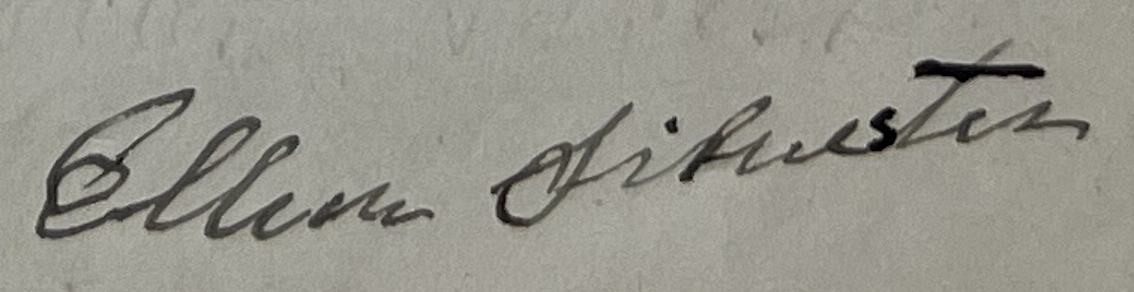
Hold on to those two crosses, because the story does not end there. Years later George signed his own will - "G. Silvester" - and Ellen, too, left her signature near the end of her life.16,17 Somewhere in those Newtown years, the two who had married with a pair of crosses had taught themselves to write their names. It is a small thing, and a quietly proud one.
Of Ellen herself we know less than we would like, and we should be honest about that. On her children's birth certificates - the details she gave herself - she said she was born in Ireland, about 1839. Because that is her own word, it is the account we lean on.18 There is a little on the other side: she married in the Scots Church, a Presbyterian church, and called herself a member of the Church of Scotland, which fits a Scottish link as easily as an Irish one; and her death record, given years later by a daughter, says Glasgow. The truth may be tangled - perhaps an Irish-born child of a Scottish family. Her father was Robert Stewart, a coach proprietor; the marriage record does not name him, and her mother's name we do not have at all.19
How she came to New South Wales we cannot yet say. She may have come on one of the schemes that brought single Irish women out after the Famine, or she may have come some other way. No passenger record has turned up for her either - for now.14 She came out somehow, a young woman on her own, and that took its own quiet courage.
A family of several churches
The Silvesters moved easily between the colony's churches. George and Ellen married Presbyterian, at the Scots Church; their daughter Sarah would marry Presbyterian too.20 Yet at the end George was buried in Church of England ground at Rookwood, and Ellen, months later, in the Roman Catholic. In a colony with no single official church, such crossings were ordinary - and they hint at a marriage between an Irish-leaning wife and an English husband who simply got on with things.
Chapter Four · 1856-1900s
A brick house in Newtown
For the next sixty years the Silvesters were a Sydney family, and mostly a Newtown one. They started at Redfern, where their first child was born, and soon settled into the inner south, where George would spend the rest of his life.
The children came steadily. Harriot, always called Henrietta, was born on Parramatta Road, Redfern, in 1856.18 Augusta - "Gussy" - followed at Newtown in 1858,21 and Sarah Ann at Newtown in 1860.22 After them came George, Lavinia, Henry, Alfred, Arthur and Edith, born across Newtown and the St George district up to 187623 - at least nine children in twenty years. On the early certificates it is Ellen who gives the details. She was the keeper of the family's facts, and of its Irish memory.
George worked as a labourer, the trade he was born to, and once - on his daughter Sarah's marriage paper - he is written down as a bricklayer.24 In the Newtown of those years the two went together. The suburb grew fast in the late 1800s, as the old farms were cut up into rows of cheap brick terraces, many of them two rooms up and two down. The brickyards, the building sites and the nearby Eveleigh railway workshops gave steady work to labourers and bricklayers alike.25
A working man's Newtown
From the 1870s Newtown was a working suburb - tradesmen, shopkeepers, factory hands and railwaymen, packed into cheaply built terraces. It was not grand, and parts of it were later called a slum. But there was work, and a steady, careful man could do more there than just get by.25 That is the measure of what George managed. Most labourers rented all their lives and died with nothing. George came to own his home.
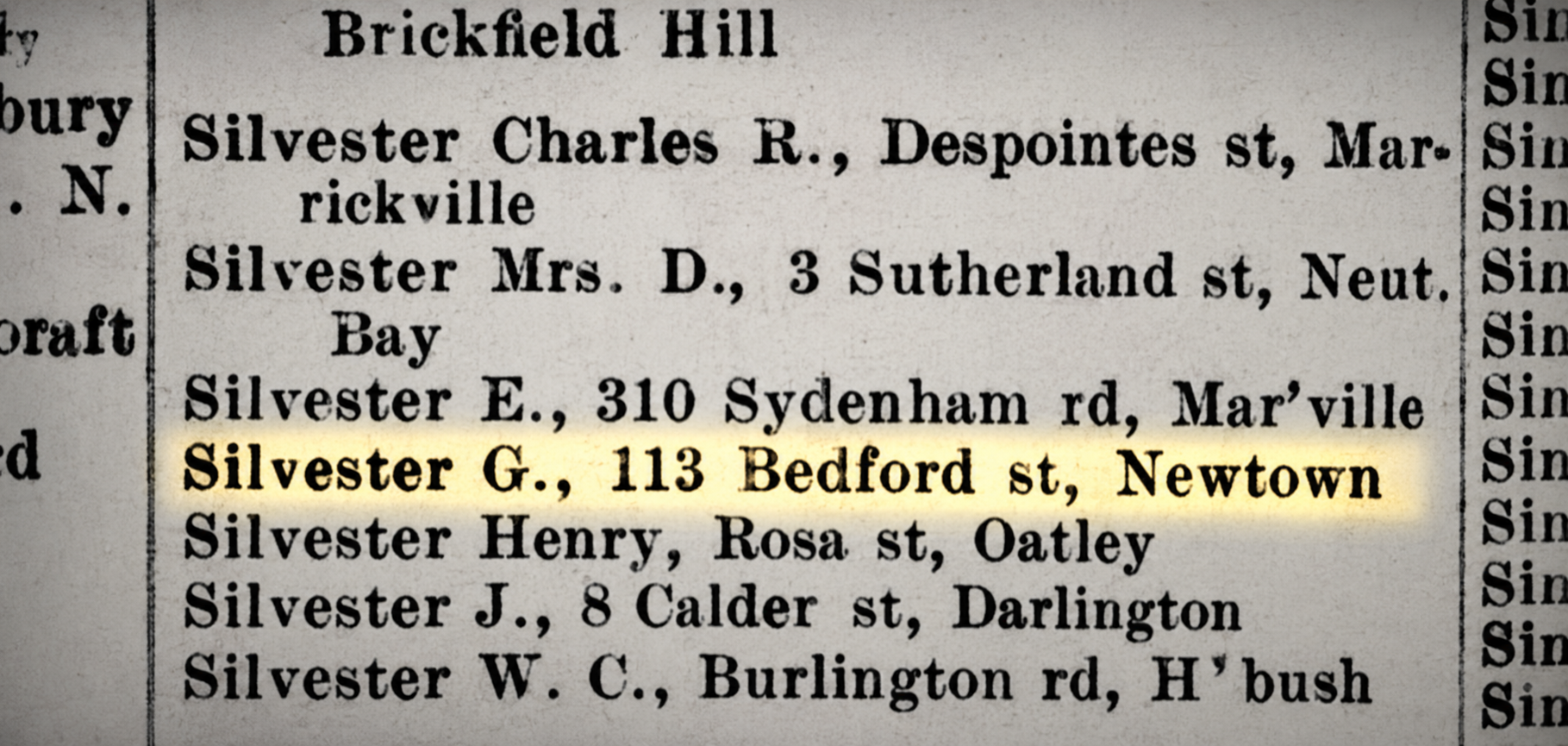
By the 1891 census the family was in Bedford Street, Newtown,26 and there - at number 113, listed again in the directories of 1901 and 191627 - they stayed. A brick house of their own, in a street of renters, was no small thing for a man who had started out in an estate cottage and a prison cell.
Word reached George, in 1888, that his father had died back in Hampshire. James Silvester had been a respected man at Pyle Farm - he was even given a public award once, for raising his family without help from the parish - but he came to a sad end, and his full story belongs to a book of its own.6,28 What matters here is a small, telling silence. When James made his will, he named four of his children. George was not one of them.28 Whether it was distance, or a falling-out, or simply that the son who had gone to the far side of the world was thought past needing it, the will does not say. It is one of those gaps a family story has to leave open - though it is hard not to wonder what that careful, upright father had once made of a son hauled up before his own squire for poaching.
Chapter Five · 1893-1924
Provider to the last
❧
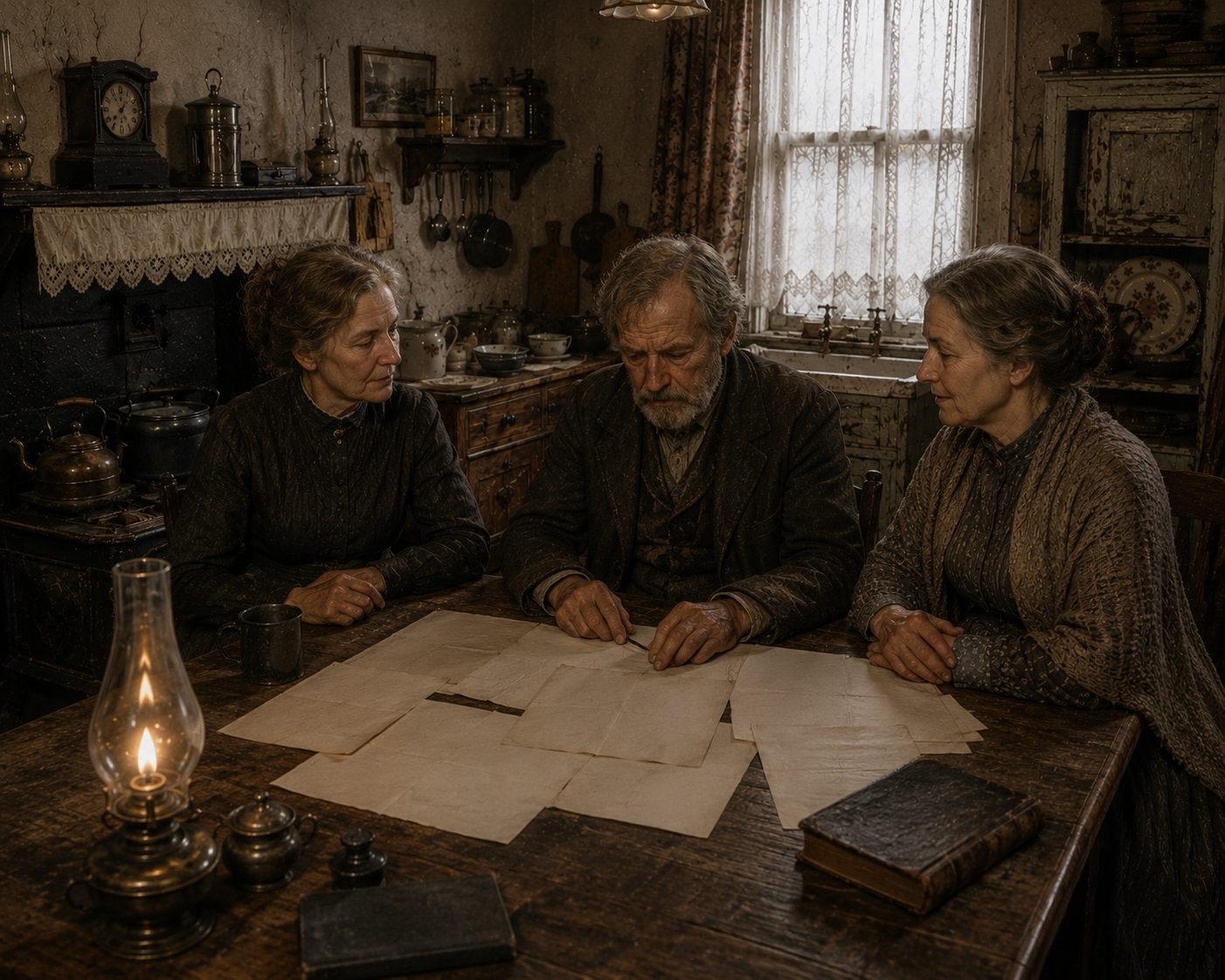
It is late in 1917, well after dark, and George Silvester is not a well man.
He is eighty-three, and the strength is going out of him a little more each month. A single lamp burns on the kitchen table in Bedford Street; the house is quiet, Ellen long since gone up to bed. He knows what is coming, and roughly when. Before it does, he means to have one thing settled.
Spread out under the lamp is a plan of the block - the house, and beside it the narrow strip of empty land at the far end, twenty feet of it. He goes over it again with a thick, slow finger. Sell the strip. Turn it into money. Ten shillings a week to Ellen, ten shillings a week to Hettie, for as long as it lasts - and the roof kept over the pair of them, whatever else happens.
Ellen, his wife of sixty-two years, who came out of Ireland on her own and married him with a cross because neither of them could write their name. And Hettie - Henrietta, their eldest girl - who never married, who has been unwell for years in a way no one has ever quite put a word to, and who will have no husband to keep her once he is gone.
That is what holds the sick old man at the table long after the house is asleep. Not himself; he is past worrying about himself now. Them. Get the figures right tonight, and the will can follow in the morning.
❧
In 1893 George gave away a daughter. Sarah Ann - "Annie" - married John Clarke, a commercial traveller, at the Hunter Baillie Presbyterian Church in North Annandale. By then Sarah was managing the Sydney Coffee Palace, a working woman with a position of her own.24,29 The poacher's daughter had come a long way - and so had the poacher.
By 1918, the plan settled in his head at last, George made it law. On the first of February he signed his will in his own hand - "G. Silvester", the name he had taught himself to write. The signature is shaky and laboured, and you can read in it just how ill he had become: the hand of a very sick man making one last careful effort for his family.16,33
The will put everything in trust. The house and land were to keep his wife Ellen and his unmarried daughter Henrietta for the rest of their lives. The twenty-foot strip was to be sold, and the money, with his savings, would pay each of them ten shillings a week, rising to a pound for whichever of them lived longer. Anything left would go to Sarah Ann. It was a poor man's instinct to protect his own, worked out with a careful man's eye for detail - and, as it happens, it was the same thing his own father had done a generation before, each man bending his small estate to shelter the women he would leave behind.
George did not live to see how it played out. He died on 28 January 1919, at the Rookwood asylum at Lidcombe, worn out by great age. He was eighty-four.30
Rookwood: care for the aged poor
"Rookwood Asylum" needs a word, so it is not misread. From 1892 it was the colony's main home for the old and infirm poor - 581 people by 1896, more than eleven hundred by 1901 - and in 1913 it became a state hospital.32 That a man who owned a house and left around twelve hundred pounds ended his days there says nothing about poverty. It says he was very old and frail in his last months, and that this was where an old colonial city looked after such people.
The family marked him the usual way, in the columns of the Sydney Morning Herald. Two notices ran on 30 January 1919 - one from "Harry, Alfred, and Hettie", one from "Mrs Parker and family" - telling friends that the funeral of their dear father and grandfather would leave his home in Bedford Street, Newtown, for Rookwood.31 He was buried in the Church of England ground there. Ellen did not outlive him by long. She died on 1 September 1919, at a private hospital at Stanmore, aged eighty, and was buried in the Roman Catholic cemetery at Rookwood.19 Within a single year, the two who had married with a pair of crosses in 1855 were both gone.
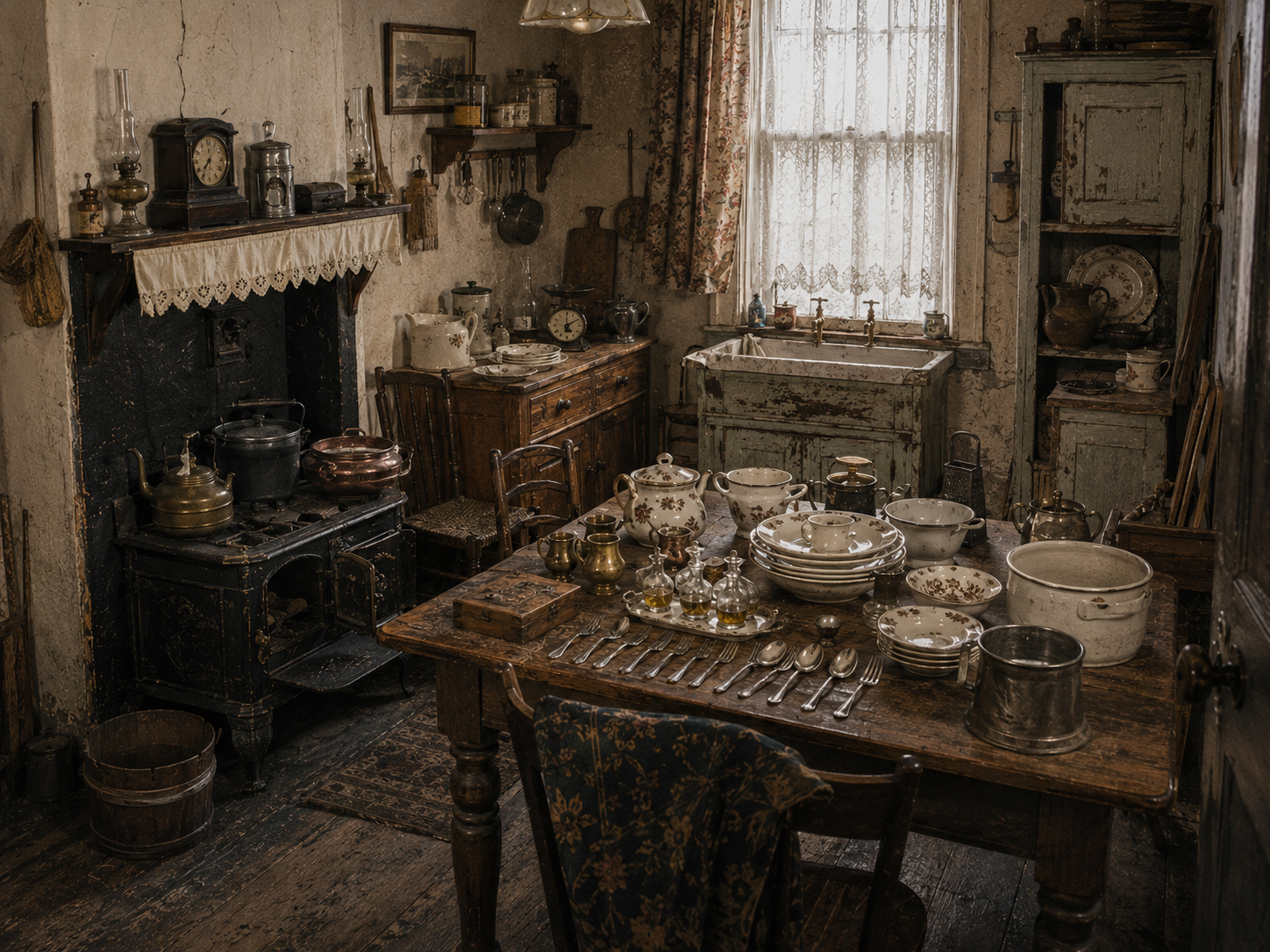
A few weeks after George died, in February 1919, a valuer from E. A. Turtle & Co. of King Street walked through the house and wrote down everything in it, room by room. It is the closest thing we have to a photograph of the home he made.34 The drawing room held a seven-piece tapestry suite, a round table, a glass mirror, two little bronze figures, a set of fire-irons and fender, and ten framed pictures on the walls. The kitchen had its clock and its safe, its pots and pans, its glassware, crockery and cutlery, an old couch and a scrub of chairs. There were three bedrooms upstairs and a laundry out the back. None of it was grand. All of it was decent, and his own.
What George left
The valuer put the house at £525 and all the furniture at just £18/1/6.34 But the furniture was never the point. With cash in hand and money in the bank, George's estate came to about twelve hundred pounds - a real sum in 1919, and far more than most working men ever saw. Think back to where he began: a farm labourer's son in a Hampshire cottage, who would likely have died with nothing had he stayed. The boy hauled out of the squire's hedge had, in the end, done well. He was almost certainly better off in Australia than he could ever have been at home - and the two crosses in the 1855 register had, by the end, become two signatures. They had learned to write their names, and probably a good deal more.
There was one last knot the old man could not have foreseen. When the estate came to be wound up, the Public Trustee found that the little twenty-foot strip could not be sold on its own: the council's rules on the smallest size of a building block would not allow it. With Ellen gone and the trust money spent, and Henrietta too unwell even to sign her consent, there was nothing for it but to sell the whole property. In October 1924 the court allowed the sale of 113 Bedford Street, and the home George had worked a lifetime to keep was let go.33,35 He had done everything right, and it still came apart at the end - which is true of most lives, and no fault of his.
Henrietta herself died that same year, 1924. She had never been a wife or a mother, and her health had been poor for a long time; but she had not been left to face it alone. Her sisters were close by - Sarah, Edith and the others - and between them she was looked after to the end, never too much of a burden on any one of them. It was, in its quiet way, the family doing exactly what George's will had tried to make sure of.
What endures
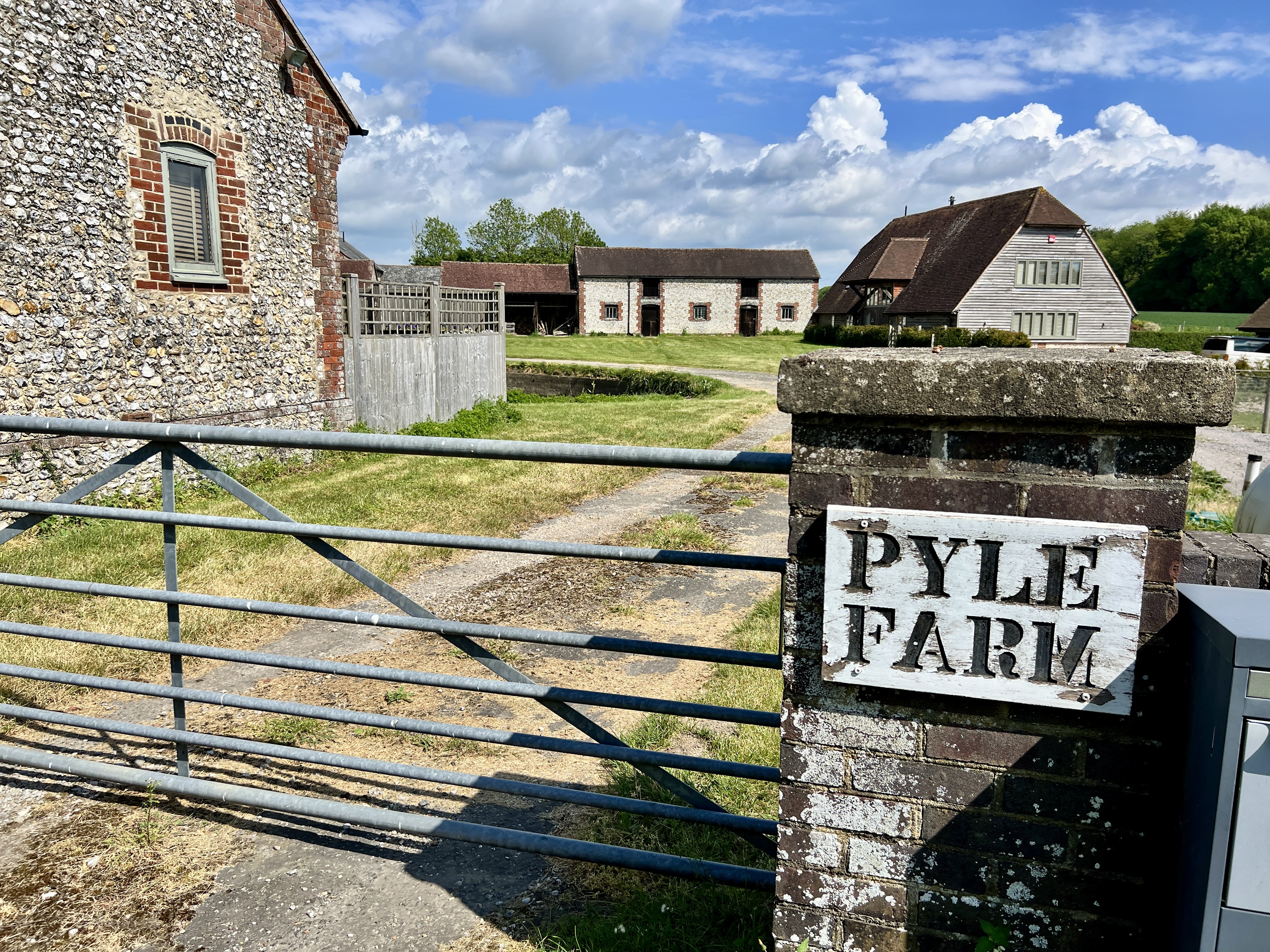
Pyle Farm still stands in the Hampshire chalk, its flint-and-brick barns much as they were when James Silvester worked them; the lane still runs past Deadman's Cottage to Idsworth. Bedford Street still runs through Newtown. And the two crosses in the Scots Church register are still there to be read.
There is still much we do not know. We have not found the ship that brought George out, or the one that brought Ellen, and we are not certain even of the country of Ellen's birth. No photograph of either of them has come down to us - we have their marks, and later their signatures, but not their faces. One day some of that may yet be found. And yet the shape of the life is clear enough, and it is a good shape: a hungry boy poaching on the squire's land, hauled up in front of that same squire; a young man getting out, and starting again at the far edge of the world; a labourer who became, against all the odds of his trade, a married man with nine children and a house of his own; and an old man bent over a sheet of paper, working out to the last how to keep a roof over the people he loved. It began with one pheasant too many. It ended with a will, a home, and a family who looked after their own. A rough start - but a good life.
Biographies
SILVESTER, George (1834-1919)
George Silvester was baptised at Holy Trinity, Blendworth, on 22 November 1834, the son of James Silvester, an agricultural labourer on the Idsworth estate, and his wife Harriet, née Wield. The family lived among the estate's farms and cottages, and in 1841 seven-year-old George was at home with his parents and five brothers and sisters.
As a young man he came before the Hampshire courts three times under the game laws between 1851 and 1853 - committed to the county gaol at Winchester in 1851 and again in 1852, then, at a single Petersfield petty sessions on 12 April 1853, fined on two separate charges (£1 10s and 10s 6d, with costs) - over £2 in all, a sum well beyond his means. The offences were committed on the estate of the very landowner, Sir Jervoise Clarke-Jervoise, who sat upon the bench. Soon afterwards he emigrated to New South Wales. No passenger record survives; the likeliest reading is of a young man getting out after one scrape too many, the gold rush of the 1850s merely easing his passage rather than drawing him.
At the Scots (Presbyterian) Church, Sydney, on 15 October 1855 - he, a labourer of Redfern, signing with his mark - George married Ellen Stewart. The couple raised at least nine children and settled by the late 1850s in Newtown, where the family remained for sixty years, latterly at 113 Bedford Street. George worked as a labourer, and once was recorded a bricklayer; unusually for a man of his trade he came to own his home, leaving at his death an estate of about £1,200.
In 1918, his health failing, he made a careful will, placing his property in trust for his wife and his unmarried, invalid daughter Henrietta. He died on 28 January 1919 at the Rookwood asylum, Lidcombe, aged eighty-four, and was buried in the Church of England ground at Rookwood.
STEWART, Ellen Menia (c.1839-1919)
Ellen Menia Stewart's origins remain unresolved. On her children's birth certificates - which she herself reported - she gave her birthplace as Ireland, about 1839; only later records, supplied by a daughter, name Glasgow, and Ireland is the better-supported reading. Her father was Robert Stewart, a coach proprietor; her mother is not known. How she reached New South Wales is unknown - she may have come on one of the assisted schemes that brought single Irish women out after the Famine, or by some other means.
A spinster of Redfern and a member of the Presbyterian Church of Scotland, she married George Silvester at the Scots Church, Sydney, in October 1855, signing the register with her mark. Over the following two decades she bore at least nine children - at Redfern, Chippendale, Newtown and in the St George district - and kept the family home in Bedford Street, Newtown. As the informant on her children's births she was the keeper of the family's Irish memory.
Ellen died on 1 September 1919 at a private hospital at Stanmore, aged eighty, some seven months after her husband. Though married in a Presbyterian church, she was buried in the Roman Catholic ground at Rookwood.
Note: biographies cover the two principals only. James Silvester and Harriet Wield (George's parents) appear on Family Group Sheet 1 (07b), and James's documented working life and death feature in the story; children's own life stories are in the group sheets and story. Ellen's Irish origin, George's motive for emigrating, and the manner of James's death are written as qualified readings per the project's agreed narrative steers.
Family Group Sheets
Sheet 1 · James Silvester & Harriet Wield
Husband
| Name | James Silvester |
| Born | bapt. 26 Nov 1809, Blendworth, Hampshire S-026 |
| Died | 2 May 1888, Deadman's Cottage, Horndean, Hampshire S-041 |
| Buried / Probate | probate Winchester, 6 Jun 1888; estate under £300 S-041 |
| Parents | Richard Silvester & Ann (Nancy) Fay S-026 |
| Occupation | agricultural labourer, Pyle Farm (for Richard Gale), 40+ yrs S-026, S-048 |
| Standing | 1846 premium for supporting 6 children without parish relief; member, Buriton Friendly Society S-048 |
Wife
| Name | Harriet Wield |
| Born | bapt. 17 May 1807, East Meon, Hampshire S-025 |
| Died | 1893, Littlehampton, Sussex S-025 |
| Parents | - (not firmly established) S-025 |
| Occupation | - |
Marriage
| Date | 8 October 1828 S-025, S-026 |
| Place | Portsea: St Mary, Hampshire |
| Religion | Church of England |
Children
| # | Name | Born | Notes | Source |
|---|---|---|---|---|
| 1 | Jesse (Jessey) Silvester | 1829 | - | S-026 |
| 2 | Jane Ann Silvester | 1831 | - | S-026 |
| 3 | George Silvester | 1834 | m. Ellen Stewart; emigrated to NSW → Sheet 2 | S-001 |
| 4 | Sarah Silvester | 1837 | d. 1901 | S-026 |
| 5 | Henry Silvester | 1839 | will beneficiary & witness; m. Mary Selina | S-041 |
| 6 | Ellen Silvester (Spiers) | 1842 | m. George Spiers, Portsmouth; executor of father's will | S-041 |
| 7 | James Silvester (jnr) | 1846 | china & glass dealer, Littlehampton; executor; d. 1910 | S-041 |
| 8 | Susan Silvester (Spencer) | 1850 | m. Elisha Spencer, Portsmouth | S-041 |
Sheet 2 · George Silvester & Ellen Menia Stewart
Husband
| Name | George Silvester(child of Sheet 1) |
| Born | bapt. 22 Nov 1834, Blendworth, Hampshire S-001 |
| Died | 28 Jan 1919, Rookwood asylum, Lidcombe, NSW; aged 84 S-016 |
| Buried | Church of England cemetery, Rookwood, 30 Jan 1919 S-016, S-017 |
| Parents | James Silvester & Harriet Wield S-001 |
| Occupation | labourer (once recorded bricklayer) S-008, S-013, S-016 |
| Property | 113 Bedford St, Newtown (CT Vol 1050 Fol 206) S-018 |
| Estate | ~£1,200 (cash £658 + realty ~£525) S-018, S-032 |
Wife
| Name | Ellen Menia Stewart |
| Born | c.1839 - Ireland (her own evidence; Glasgow on later records) S-008, S-024, S-015 |
| Died | 1 Sep 1919, Braeside Private Hospital, Stanmore; aged 80 S-015 |
| Buried | Roman Catholic cemetery, Rookwood, 2 Sep 1919 S-015 |
| Parents | Robert Stewart (coach proprietor); mother - S-015 |
| Occupation | - |
Marriage
| Date | 15 October 1855 S-007 |
| Place | Scots Church, Pitt Street, Sydney |
| Reg. no. | 126 V82/1855 |
| Religion | Presbyterian |
| Minister | Rev. James Fullerton, LL.D. |
| Witnesses | James Stoddart; Ellen Stoddart (both of Redfern) S-007 |
Children
| # | Name (later surname) | Born | Notes / later life | Source |
|---|---|---|---|---|
| 1 | Harriot (Henrietta) Jane | 1856, Redfern | unmarried, invalid; life tenant of George's estate; d. 1924 | S-008 |
| 2 | Augusta ("Gussy") | 1858, Newtown | d. 1943 | S-009 |
| 3 | Sarah Ann ("Annie") (Clarke) | 1860, Newtown | m. John Clarke 1893; manageress, Sydney Coffee Palace | S-010, S-013 |
| 4 | George E | 1863, Newtown | - | S-023 |
| 5 | Lavinia | 1865, Newtown | - | S-023 |
| 6 | Henry J | 1867, St George | mourner at father's funeral ("Harry") | S-023, S-017 |
| 7 | Alfred Ernest | 1870, St George | mourner at father's funeral | S-023, S-017 |
| 8 | Arthur George | 1873, Newtown | witness at Sarah's 1893 marriage | S-023, S-013 |
| 9 | Edith Florence (Parker) | 1876, Newtown | m. - Parker; informant on Ellen's death | S-023, S-015 |
References
References & sources (context sources marked; every in-text number resolves here)
- Baptism of George Silvester, Holy Trinity, Blendworth, 22 Nov 1834 [S-001].
- Silvester family roots - Froxfield, Priors Dean & Hawkley (owner research) - family tradition [S-042].
- 1841 England census, Blendworth [S-002].
- Life & wages of a Hampshire agricultural labourer, 1840s-50s - context; BAHS/AgHR, History of Wages [S-035].
- The Idsworth estate & the Clarke-Jervoise family - context; Wikipedia, Rowlands Castle Heritage Centre [S-040].
- James Silvester at Pyle Farm (for Richard Gale, 40+ years); 1846 Friendly-Society premium for supporting six children without parish relief [S-026, S-048].
- 1878 Ordnance Survey map, Blendworth & Idsworth [S-043].
- Poaching conviction (game laws), Hampshire Chronicle, 13 Dec 1851 [S-003].
- Poaching conviction, Hampshire court, March 1852 [S-004].
- Petersfield petty sessions, 12 Apr 1853 - Hampshire Telegraph, 16 Apr 1853 [S-005].
- The game laws & poaching in Victorian England - context; ResearchGate, Rural History (Cambridge) [S-034].
- The end of convict transportation to NSW (1840) & the shift to assisted/free migration - context; State Library of NSW, National Museum of Australia [S-036].
- The New South Wales gold rush of the 1850s - context; Wikipedia, National Museum of Australia [S-046].
- Irish Famine emigration & assisted passages for single women - context; Women's Museum of Ireland, richardjohnbr [S-047].
- Marriage of George Silvester & Ellen Stewart, Scots Church, Sydney, 15 Oct 1855 [S-007].
- George Silvester's signature, from his 1918 will [S-050].
- Ellen Silvester's signature, 1919 [S-051].
- Birth of Harriot (Henrietta) Silvester, Redfern, 1856 - Ellen's own evidence of her Irish birth, given on her children's certificates [S-008].
- Death of Ellen Menia Silvester, 1 Sep 1919 - father Robert Stewart, coach proprietor; Glasgow given on this later record [S-015].
- The Scots Church & Presbyterianism in colonial Sydney - context; Dictionary of Sydney, Wikipedia [S-037].
- Birth of Augusta Silvester, Newtown, 1858 [S-009].
- Birth of Sarah Ann Silvester, Newtown, 1860 [S-010].
- Births of the younger Silvester children, Newtown & St George district, to 1876 [S-023].
- Marriage of John Clarke & Sarah Ann Silvester, 1893 (George recorded "bricklayer") [S-013].
- Newtown, New South Wales - context; Wikipedia, Dictionary of Sydney [S-038].
- 1891 NSW census, Bedford Street, Newtown [S-011].
- Sands Directory, Sydney - 113 Bedford Street, 1901 & 1916 [S-014, S-033].
- Will & probate of James Silvester, Winchester, 1888 [S-041].
- Marriage notice, Clarke-Silvester, Sydney Morning Herald, 28 Mar 1893, p.1 [S-012].
- Death of George Silvester, 28 Jan 1919 [S-016].
- Funeral notices, Sydney Morning Herald, 30 Jan 1919, p.5 - Trove (NLA) [S-017].
- Rookwood / Lidcombe asylum & the care of the aged poor - context; Wikipedia, Dictionary of Sydney [S-039].
- Will of George Silvester (1 Feb 1918) & probate [S-018].
- Estate inventory (E. A. Turtle & Co., 7 Feb 1919), itemised room by room [S-049 / S-021].
- Deceased-estate affidavit, Supreme Court of NSW, 23 Oct 1924 [S-019].
- The "Swing" riots & machine-breaking in Hampshire, 1830 (Havant & Emsworth, a few miles from Blendworth; transportations follow) - context; Hampshire History, Hampshire Archive Trust [S-045].
Image Sources
- 1853 court report - Hampshire Telegraph, 16 Apr 1853 (British Newspaper Archive) [S-005].
- 1916 directory entry - Sands Directory, Sydney, 1916 [S-014].
- George Silvester's signature (from his 1918 will) [S-050]; Ellen Silvester's signature, 1919 [S-051].
- Locator maps (Blendworth & Froxfield in England; Newtown in Sydney) - prepared for this book by the family.
- 1841 census household - 1841 England census [S-002].
- 1878 Ordnance Survey map - Blendworth / Idsworth (Hants LXVII/LXVIII NE) [S-043].
- Drawing room & kitchen item images - from the 1919 estate valuation, E. A. Turtle & Co. [S-049 / S-021]; reconstructed for this book.
- Pyle Farm today - photograph from the family's own collection, 2026 [S-044].
- Reconstructions (the opening scene, the Petersfield bench, the wedding, the will) are original artwork created for this book - an artist's idea, not photographs.
- No photograph of George or Ellen Silvester is known to survive.
Back Cover
One pheasant too many - and a hard start became a good life.
George Silvester was a Hampshire farm boy who poached on the squire's land and fell foul of the law once too often. He sailed for New South Wales to begin again, and there - with Ellen Stewart, a young woman most likely out of Ireland - he raised nine children in working-class Newtown and, against every odd of his trade, came to own his own home.
From a poacher's dock to a careful old man writing his will by lamplight, this is the story of two people who could not, at first, even sign their names, and of the family they built at the far edge of the world.