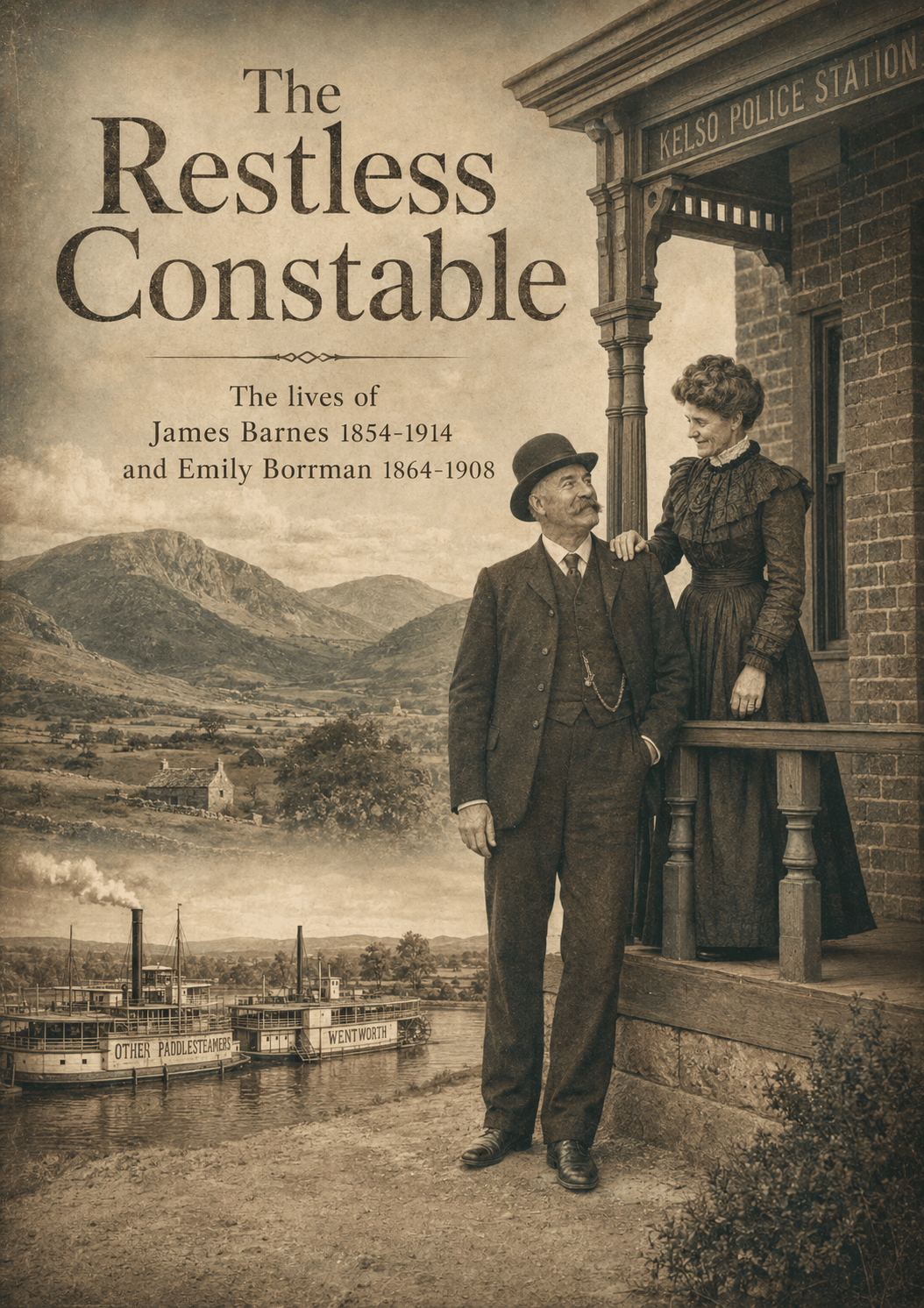
The Restless Constable
❧
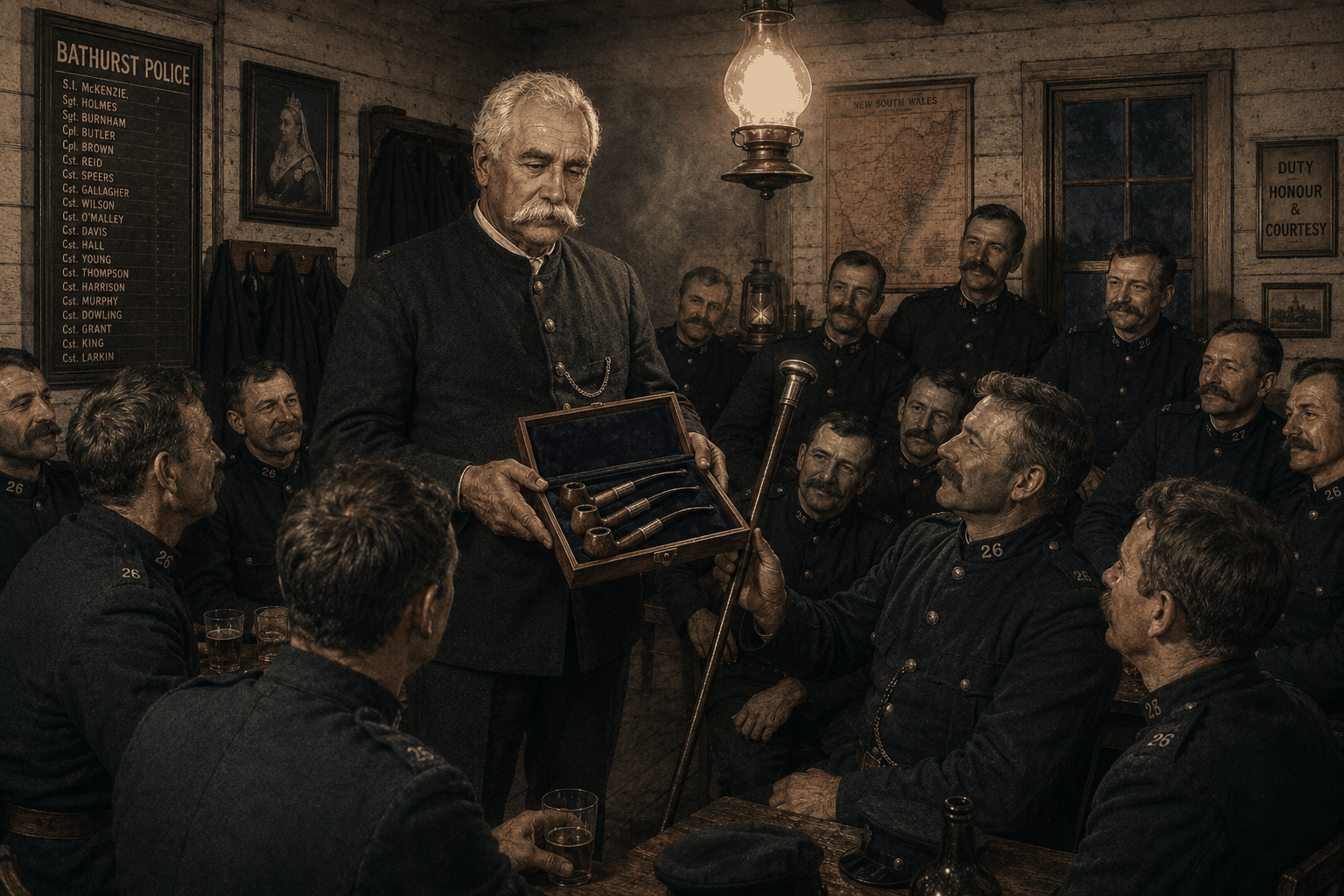
It is the evening of 1 April 1914, at the Police Barracks on the corner of William and Durham streets in Bathurst, and the room is thick with pipe-smoke and the smell of lamp oil and wet wool coats. A ring of constables has drawn in close, boots scraping on the boards, and in the middle of them stands a big man - six feet three, eighteen stone - turning a set of silver-mounted pipes over and over in his hands, a parting gift he does not quite know what to do with.
He is not a talker, this one, and everybody in the room knows it. Thirty-four years in the force, and Constable James Barnes has always let the work speak for him. But tonight is his last night among them, and they want the tale, and so, a little gruffly, looking mostly at the pipes in his hands, he gives it to them.
A tenant farm in the green fells of the Lake District, and a boy who studied maps. New Zealand, and a long wander. A gold strike at Temora thrown away on a voyage home to a country that no longer fitted him. The tin-shed lock-up in the silver country, with the drunks leg-ironed to a log through the freezing nights. Three days and nights in the trenches on the hill above Broken Hill, waiting for the relief that would not come. A wedding by a river. A wife buried across another one.
The younger men lean in. Some of them have known the same country, the same coach roads and cold cells, and they nod along.
"And Kelso," he tells them at the last, with something very like relief in his flat voice, "is the quietest place I ever struck."
There is a laugh at that, and a thump of approval. Sub-Inspector McKenzie steps forward and presses the pipes on him properly - "the pipe of peace," he says, "for a man who has earned a quiet smoke" - and there is a cheer, and a scrape of chairs, and somebody starts filling glasses.
What James does not say - what he cannot know, standing there heavy and tired and quietly pleased - is that he has just ten weeks left to live. This is his tale, and Emily's, and it is very nearly told.
❧
Introduction
This is the story of James Barnes and his wife Emily - a New South Wales country policeman and the goldfields girl he married at Wentworth. James was born on a Lake District tenant farm, in Cumbria, in 1854, and died at the Kelso police station in 1914. Emily was born on the Bendigo diggings in 1864, into a devout German Lutheran family, and died of consumption in 1908. Between those dates lies a restless, roving life: a dozen postings across the back country of colonial New South Wales - the river port of Wentworth twice over - a gold strike, a voyage home to England and back, the great Broken Hill strike, and a private crisis he survived to serve another eleven years.
Not everything can be known. Whole stretches of James's early life - his years in New Zealand, his first years in Sydney - leave almost no trace, and where the paper runs out we say so plainly rather than invent. Emily's story is told here in her own right, and not merely as a name on her husband's certificates. The book is built from the records that survive - police registers and gazettes, certificates, newspapers, and James's own retirement speech - and from the memories of his youngest daughter, Ivy "Doll" Barnes, who told her family's story in her nineties.
We cannot be sure of everything that happened. Where a fact is firmly documented we state it plainly; where it is likely but not certain we say so; where it comes down only as family memory we name it as such. The pictures are artist's reconstructions of scenes no camera recorded, never passed off as photographs. Nothing here has been invented to fill a gap.
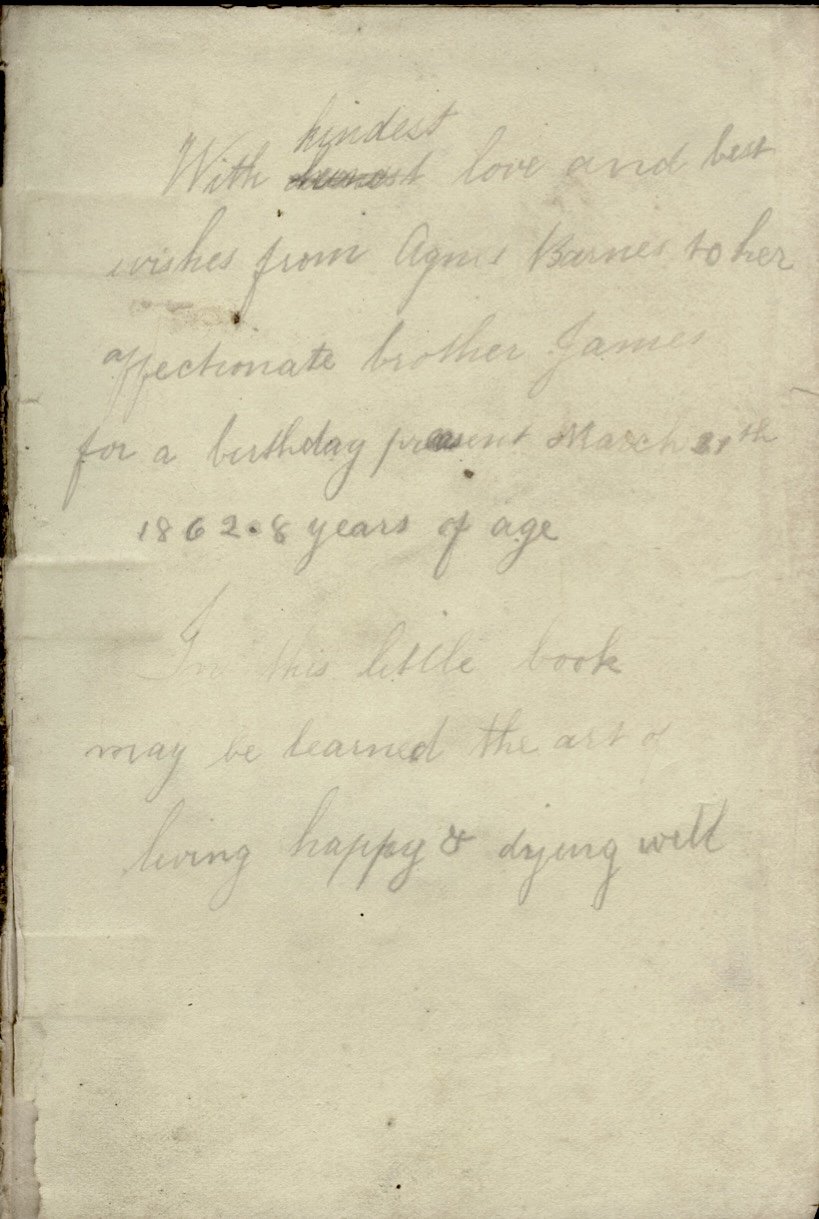
Its flyleaf carries the words his sister chose for him: "In this little book may be learned the art of living happy and dying well." He would do both.
Chapter 1. Garnett House
❧
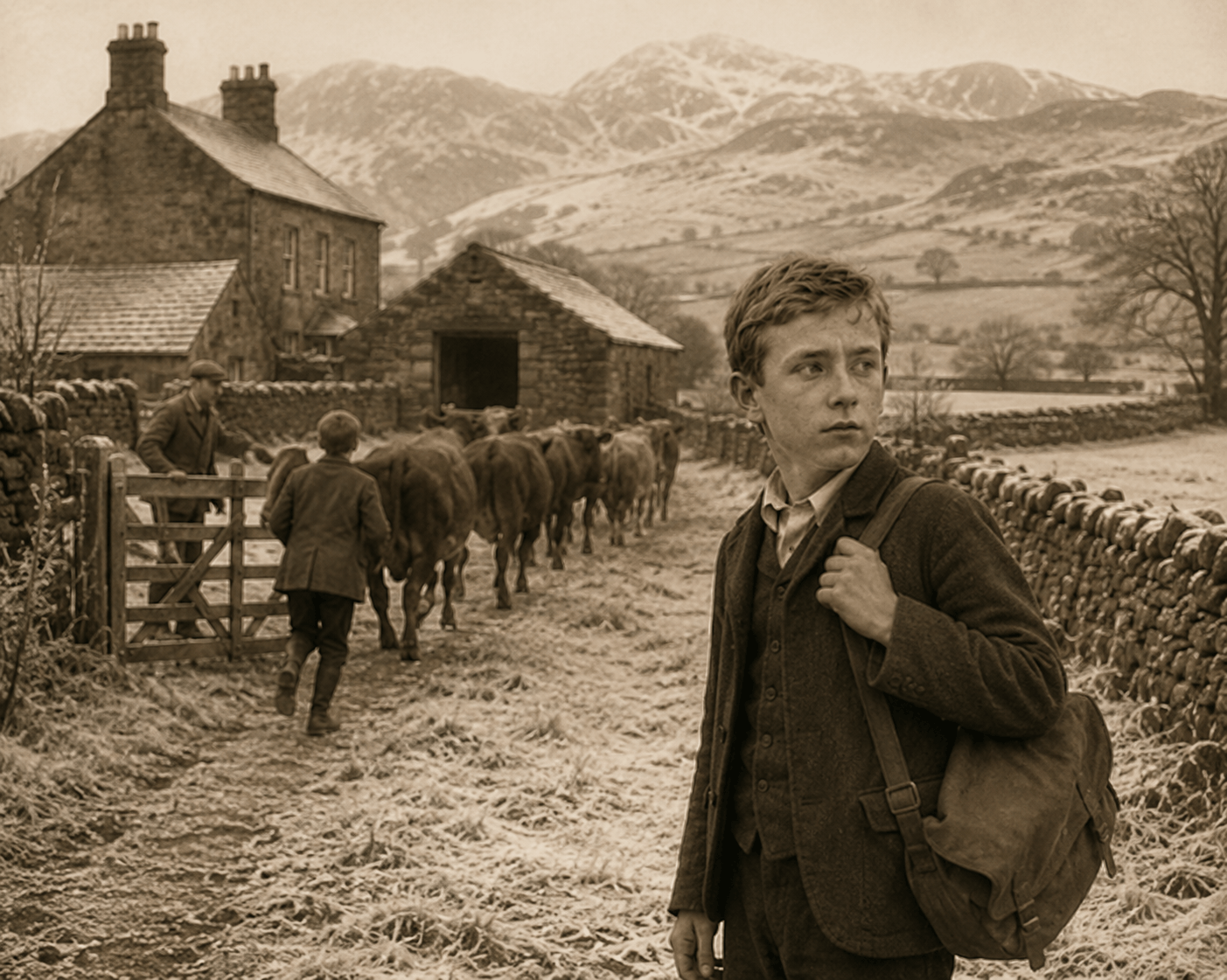
It is a winter morning about 1868, at Garnett House near Burneside, and the fields are white with frost.
James Barnes and his younger brother William hurry the cattle toward the shed before school, their boots crunching across the frozen ground. Beyond the farm the stone walls climb the hillsides toward the dark fells of the Lake District.
"Get around behind them," their father calls. "Don't let that one turn."
James hears him, but only partly. The day before, at school, he had been studying a map. Not Westmorland. Not England. The whole world - Australia, New Zealand, places so distant they seemed almost impossible.
"James."
He looks up. His father is watching him. "You listening, lad?"
"Sorry, Pa."
The cattle disappear into the shed. His father shakes his head and latches the gate. "Off to school with you."
James starts up the lane, satchel over his shoulder. Behind him lie Garnett House and the life he has always known. Ahead, somewhere beyond the hills and beyond the sea, are the places he cannot stop thinking about.
❧
James Barnes was born on 31 March 1854 at Garnett House, in the little township of Strickland Ketel, near Burneside, about three miles from Kendal.1 This is the southern edge of the Lake District, in the old county of Westmorland - the part of Cumbria known for its walkers and poets, its stone-walled fields and its soft green hills under hard grey weather. It is beautiful country, and it is hard country, and the Barnes family were part of it in the fullest way.
Garnett House itself was no ordinary farmhouse, and it is worth pausing on, because it was the very first thing the world ever set in front of James Barnes. It is an old, old place - old enough to be a listed building today. Behind its plain eighteenth-century front stands a sixteenth-century range built around a small medieval tower, one of the squat defensive "pele" towers thrown up across this border country between the fourteenth and sixteenth centuries, when raiders came down out of Scotland and a farming family kept its people and its beasts behind walls four feet thick. Only in the more settled years after the Act of Union in 1707 did such fortress-farms ease into ordinary homes. Older still is the house's one brush with the great world: in the early 1500s Garnett House belonged to Sir Thomas Parr of Kendal, whose daughter Katherine Parr would become the sixth and last wife of King Henry VIII.45 This was the house a Cumbrian farm boy grew up in - thick-walled, stone-flagged, slate-roofed, half a thousand years deep - and, entirely in character, it was the house he could not wait to leave.
The tenant hill-farmer's world
The world James left was the small hill farm of the Lake District: permanent pasture, sheep on the fells, a few dairy cattle, oats and roots in the low fields, the whole worked by the family and a hired hand or two through a fixed round of seasons. A tenant farmer like Anthony stood well above the labourer - he ran the place, hired the men, sat respectably at chapel - but he did it on rented ground, at a landlord's will, and the rent came due whatever the weather did. It was a settled, unhurried, bound sort of life, tied to the same fields year after year. It was exactly the life James chose not to live.4
They were no newcomers. The Barnes had farmed this corner of the fells for generations, with a branch of the family further north at Orton, in the high limestone country toward the Eden valley.2 They were the kind of long-settled, respectable, church-going people a district is built on - known at market, known at chapel, their name on the same fields their grandfathers had worked. James's father, Anthony Barnes, held Garnett House as a tenant farmer, working some 188 acres with the help of three labourers.1 A tenant, note, not a landowner: he farmed another man's ground, however well, and paid his rent at the term days. The family were people of some standing in the parish for all that: James's father and grandfather sat on the local juries and helped oversee the parish funds for the poor, and they carried off prizes for their cattle and their vegetables at the district agricultural shows.2 It was a comfortable, standing sort of life, but it was not his own land, and there is something in that fact that helps explain the son who could not wait to leave it.
James was the third surviving child of Anthony and his wife, Margaret Ellwood.1 He was named for his uncle, James Martindale Barnes, a well-known botanist of mosses and ferns, a man of some local reputation from the same Selside stock - a reminder that this was a family that produced more than farmers.2 When the census-taker came round in the spring of 1871, James was seventeen and set down plainly as a "farmer's son", one of a full house of brothers and sisters helping to work the land.1
A farmer's son he was; a farmer he would not be. We do not know exactly what turned him outward - only that, alone among a family who stayed close to home, James looked past the fells. He was a boy who studied maps. The world in the 1870s was opening up to people like him as never before. Steamships were beginning to shorten the great oceans; colonial governments on the far side of the earth were crying out for young men and women, and helping to pay their fares. More than half of the migrants who left for Australia and New Zealand in those years travelled on an assisted passage.3 Ships left the ports of the north of England every week for places that, on a schoolroom map, looked almost impossibly far. James decided to go and see them - though, as it turned out, he went the long way round.

Chapter 2. The Restless Years
❧
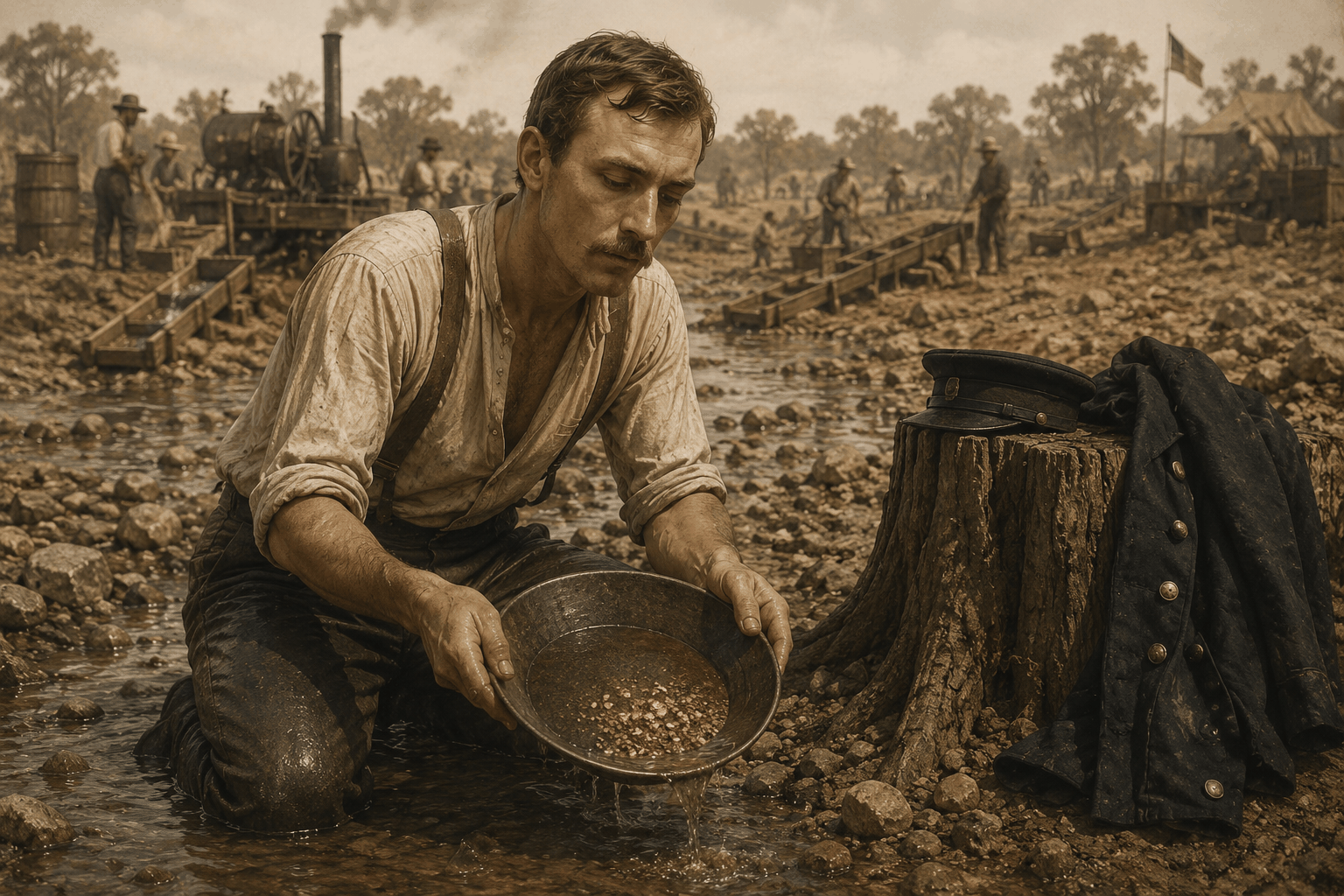
It is a fading afternoon in April 1882, down in a dry creekbed on the Temora field, and Constable James Barnes is off duty and up to his boots in the wash.
The worst of the summer heat has broken at last; the air is cooling toward evening, a small mercy after months of it. His own temper has not cooled with the weather. His tunic hangs over a stump. He is stripped to a grubby shirt, sleeves rolled, working a claim he has been at quietly on his rest days, and he is in a black mood. Three shillings. Three shillings and his name in the paper, in front of the whole district, all because that fool Simmons could not keep a civil tongue in his head - and because he, James, who never lifts a hand to anyone, had lifted one to him. "Softhead", was the word. He drives the pick into the bank and mutters it under his breath, "Softhead," harder than the dirt needs.
Around him the field mutters toward evening: cradles going somewhere along the flat, the thump of a distant puddling machine slowing, a man calling his mate home, the endless dry smell of eucalyptus and clay and horse. He is sick of it - the dust in his teeth, the cracks in his hands, the whole thankless business of keeping the peace among twenty thousand fortune-hunters who despise him for the coat.
Then his boot turns something in the gravel. A stone, he thinks, and nearly leaves it. But he bends, and works it loose, and turns it in his fingers - not a stone. Heavier than a stone. Dirty, crusted, ugly. He spits on it and rubs it with his thumb, and under the dirt there is a hint of dull yellow.
He carries it to the puddle of muddy water and washes it, slow and careful, the practised swirl and tilt. The mud thins away. It is not much - not the shouting yellow of a digger's dream, not a fortune in the dish - but it is a nugget, a true nugget, and there is colour enough in it to be worth the having.
James stands there a long moment with the water dripping off his wrists, and the noise of the field seems to go far away. It is not that the thing in his hand will make him rich. It is that it is enough - enough to be a reason, enough to be a door. He is already somewhere else: on the deck of a homeward ship, in a green Cumbrian valley, walking up a certain lane with his family coming out to meet him.
To blazes with Simmons. To blazes with the three shillings and the dust and the coat.
By the time he climbs out of the creekbed, he has decided. He is going home.
❧
James reached Australia by the roundabout road, and told the story himself, near the end of his life, in a retirement speech a Bathurst paper wrote down almost word for word.5 He came out, he said, through New Zealand, where he "spent his time in travelling about the country", before he landed at Sydney on the ship Hero in 1876.5 Of those New Zealand years no record survives at all, and of his first years in Sydney almost nothing - two silent stretches near the start of a life that is otherwise remarkably well documented. It is worth pausing on the silence rather than papering over it. A single young man with no property, drifting from place to place looking for work, simply left little behind him; there are hints in the records of a James Barnes moving about the colony in these years, but nothing that can be pinned down for certain beyond his own word that he arrived. We name the gap, and leave it open.
What is certain is that in 1880, in his twenty-sixth year, he joined the New South Wales Police, and was almost at once sent up-country to Temora.6 Temora was a latecomer among the goldfields. The great rushes of New South Wales had been thirty years before, in the 1850s and 60s; by 1880 most people thought the easy alluvial gold was long gone. Then, in the autumn of that year, payable gold was found on the dry plains near Temora, and the old madness came back all at once. The field was proclaimed in June 1880, and within about five weeks perhaps twenty thousand people had poured in from every direction.7 They threw up a "bark town" half a mile long - tents, hessian humpies, bark shanties, Cobb and Co. stables and a rough street of hotels - almost overnight, on a flat that was chronically short of water. The diggers were so thick in the low scrub that they "cooeed" to find one another; the puddling machines turned all day, working the wash-dirt for a few grains a dish. Into this raw, crowded, thirsty rush a brand-new probationary constable walked with his baton, to keep the peace among men who had come to get rich or die trying.7
It was hard, hot, thankless work, and even the most patient man frayed under it. In March 1882, only weeks before he changed his life, James lost his temper. In the barracks a fellow constable, John Simmons, taunted him - called him a "softhead" - and James, who was by every other account one of the mildest men in the force, struck him. It went to court. He was charged with the assault, and it must have stung badly for a careful, respectable man to stand there and answer for it. What is telling is how the case went: witness after witness got up not to damn him but to defend him, calling James "one of the best-tempered men I have met." He was fined three shillings, a trifle in money but not in pride.8 It is the single blot on an otherwise clean record, and, oddly, it makes him more likeable, not less: even the patient have a breaking point, and his came from a jibe, not from cruelty.
A good find, and the gambler's fever
A rush field ran on hope. A man pegged a claim, sank a shaft to the "wash", and puddled the dirt for a few specks of colour - a lottery of water, luck and rumour. A red flag hoisted over payable gold could nearly get a man mobbed. In that world a single "good find" was enough to make a steady constable throw over pensionable work and sail for the far side of the earth, which is exactly what it did to James. His own name for it was the "restless fever."7
Then, weeks later, in April 1882, came the gold. On his rest days James had been quietly working a claim of his own, and he struck what he called "a good find." As he told it, "with the restless fever in him, born of his wanderings in New Zealand," he decided there and then to quit the force and turn the gold to the use "that best suited his temperament."9 This was the gambler's logic of the diggings: a single lucky wash was enough to make a man throw over steady, pensionable work and gamble the rest on a dream. It was enough for James. But the dream he chased was not another claim. It was home.
He went back to Sydney, drew his gold, and boarded a homeward-bound ship, meaning to go back to the north of England for good. Whether it was still a sailing ship or one of the new steamers now shortening the run we cannot say for certain; either way it was a long haul, many weeks at sea, out around the underside of the world, the seasons running backward as he went. He had left as a farmer's son of little means; he came back a travelled man with money in his pocket, and he must have imagined the walk up the lane to Garnett House a hundred times on the way.
And then it did not take. "When London was reached," the paper recorded him saying in his dry way, "the acclimatised Antipodean found the cold too much for him."9 After years under the hard sun of the Riverina, the grey English winter got into his bones and would not come out. There was more to it than the weather, as the next scene will show; but the weather is what he said, and it will do as a shorthand for a deeper truth. And here is the true measure of how little the old country still held him: within a few months he was heading south again on the very same ship that had carried him home - by his own telling the identical vessel, as though he had scarcely had time to step ashore. He had crossed the whole world twice in under a year, chasing a home that turned out to be behind him, not ahead. After a lapse of about ten months out of uniform, he was back in the force, "representing the law at Deniliquin."5
❧
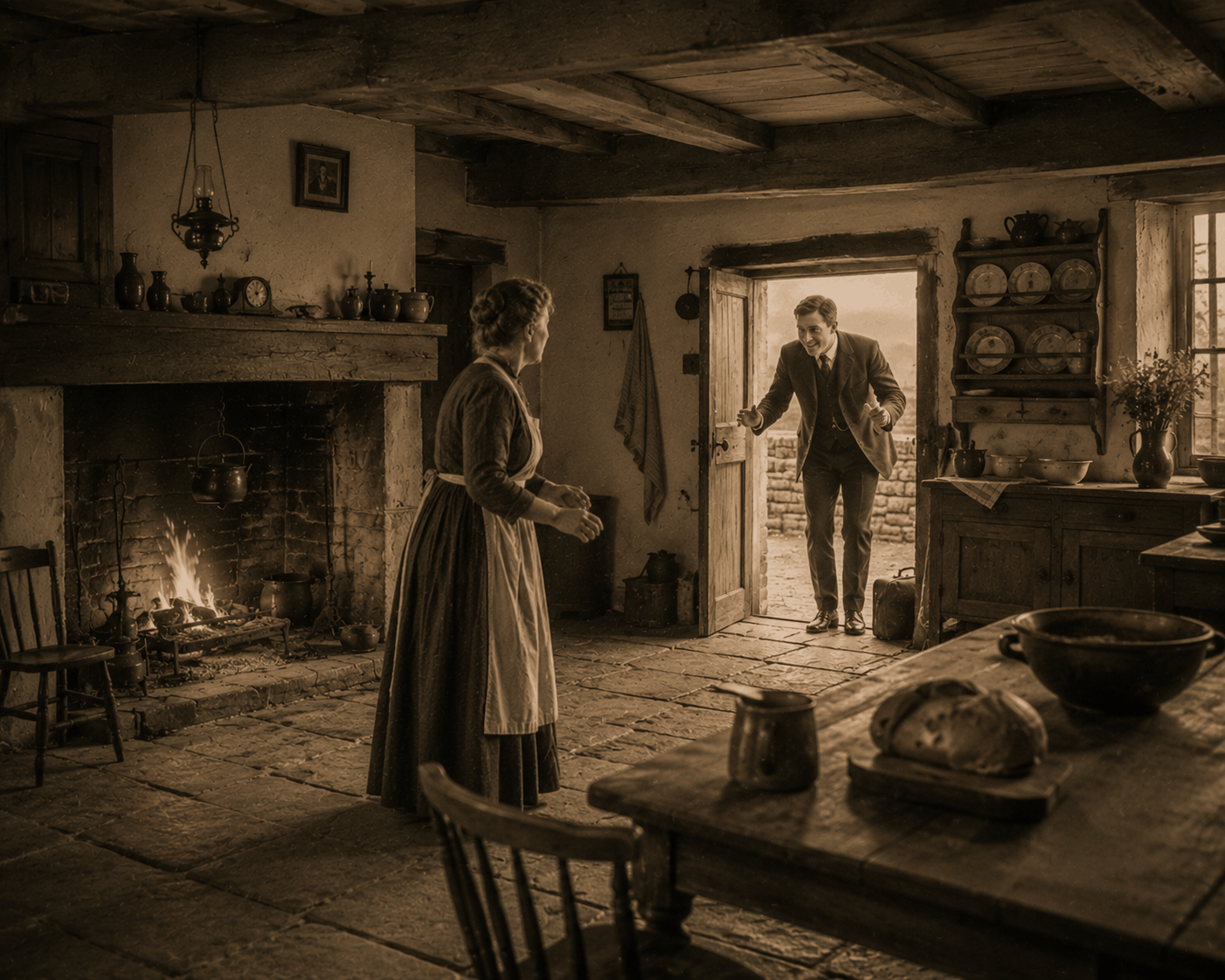
It is autumn 1882, and the train is climbing into familiar country. James looks out of the carriage window as the stations flash past, reading names he has not seen for six years, until - home.
He steps down onto the platform at Burneside carrying little more than a bag and the experiences of half a world. The air feels colder than he remembers, and the light is different, the sun already low over the fells, the days shortening.
He walks the familiar lane toward Garnett House. Every turn is known to him - the stone walls, the hedgerows, the fields running away toward the hills. Nothing seems to have changed.
His mother is in the kitchen. He opens the door slowly. Margaret looks up from her work and, for a moment, simply stares - here is her son, a man now, and so well dressed that she hesitates, uncertain who he is.
"Ma? It's me. Did you get my letter?"
For a heartbeat she says nothing. She had the letter, but it has not readied her for the shock of him. Then come the embraces, the questions, the laughter, and the strange awkwardness of years disappearing in an instant. Anthony is called in from the field - older than James remembers, still solid, weathered by work; they shake hands, stand awkwardly a moment, then talk as though no time has passed.
Sisters arrive, brothers drift in and out, neighbours call. Everyone wants to know what he has seen - New Zealand, New South Wales, ships, distances that sound almost unreal in a Cumbrian farmhouse. And gold. He shows them the gold.
That night James lies awake in the room where he slept as a boy, listening to the old house tick and settle, and finally puts his finger on what has been troubling him under all the pleasure of being back. It is not the cold. It is this: nothing here has changed - except him. He no longer fits the shape of the life that is waiting for him. Somewhere in his months at sea, without meaning to, he became a colonial. Before the spring he will be on the ship again, heading south, for good this time.
❧


Chapter 3. The Constable's Beat
❧
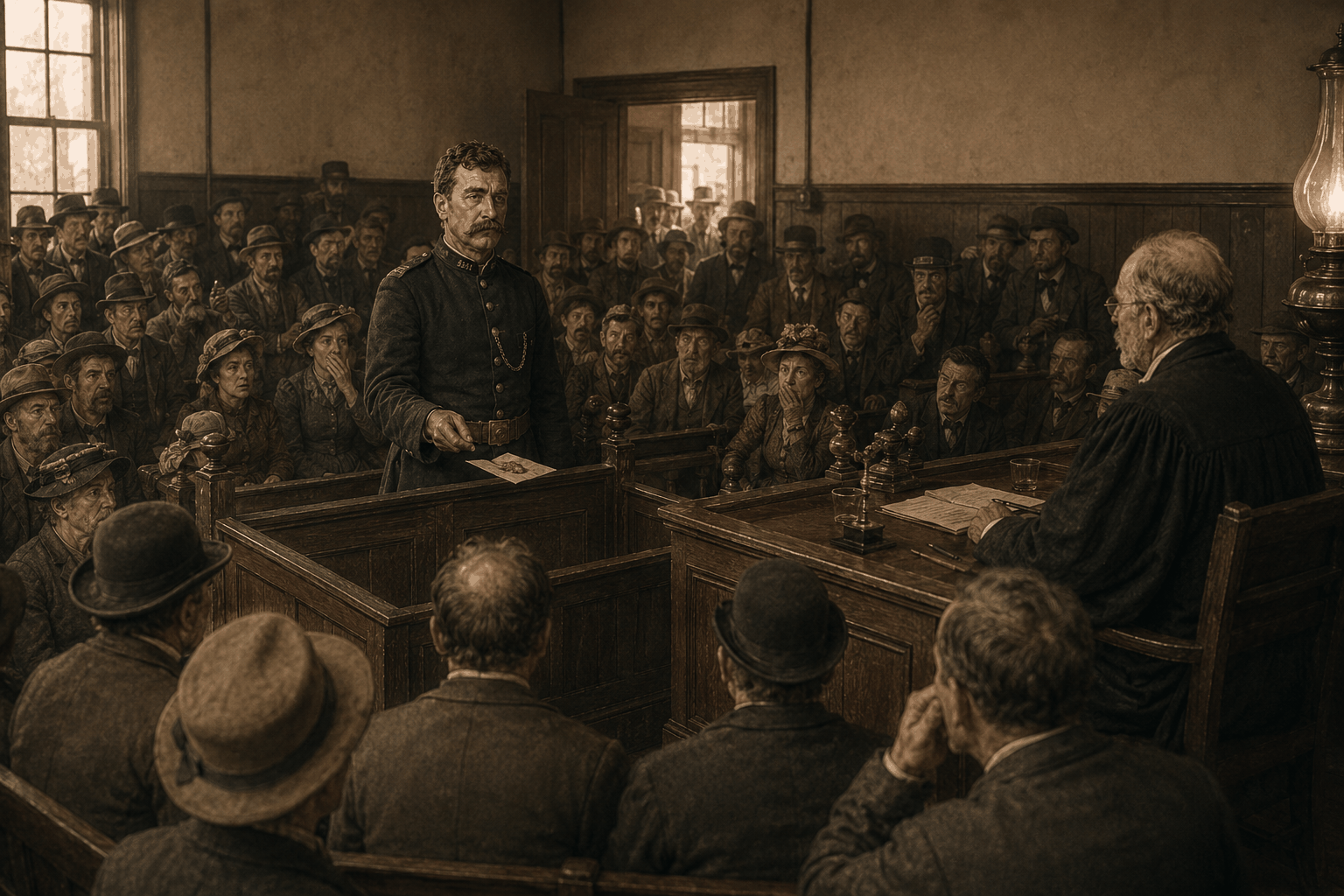
It is a raw June morning in 1887, in the crowded police court at Hay, out on the frost-bitten Riverina plain. The winter light is thin at the windows and everyone has kept their coats on; a small fire does little against the cold, and the room is packed with idlers who have come in out of it for the entertainment, and it smells of damp wool and pine boards and last night's beer.
A brawl at Tattersall's Hotel is being tried - a Saturday-night affair of drink and fists that ended, as these things do, in blood on the sawdust. Constable James Barnes, thirty-three, steps up into the witness box, straight-backed in his uniform, holding a small folded paper packet carefully in one big hand.
The magistrate looks at him over his spectacles. "And what, Constable, did you recover at the scene?"
James does not answer at once. He sets the packet down on the ledge of the box, and unfolds it, corner by corner, taking his time, aware that the whole room is watching his hands. Then he lifts it and lays its contents on the bench in front of the magistrate, in plain view of the court: a torn scrap of a man's ear, bitten clean off in the fight and picked up off the bar-room floor.
"The evidence, your honour," he says.
The court leans in as one, then recoils as one. The magistrate stares down at the thing over his spectacles as though it might move. A woman near the front puts a gloved hand to her mouth; somewhere near the back a man makes a noise caught between a laugh and a gasp, and is hushed.
James says not one word more than he has to. He is a man of few words at the best of times, and he has learned that a country court is like any crowd - it remembers a thing far better than a speech. He simply produces the thing itself, and lets it speak for him, and stands there waiting, calm as a Sunday.
The bitten ear will be in the newspapers within the week. The story - half horror, half low comedy - will follow Constable Barnes from town to town for the rest of his career, told and retold by men who were not even there.
He steps down from the box. There is a coach of prisoners to escort in the morning, two hundred and fifty miles of open plain between here and the silver country, and just now the constable would very much like his tea.
❧
The years from 1883 to 1891 were country policing at its hardest, and thanks to James's service card we can now follow them almost month by month.10 He was sworn back in at the Sydney depot in January 1883 and posted to Deniliquin, a settled Riverina wool town on the Edward River, home of the famous Peppin merino stud.10 After the roar of Temora it was steadier work, but real work all the same: the records show him there in 1883 and 1884 taking part in a run of arrests - a conspiracy case in which he and two other officers took up three men, Mason, Purcell and Dixon, and a robbery in which he and Constable Geraghty arrested a woman named Annie Wilson over the theft from a Chinese storekeeper, Charley Ah Song.11 It is the ordinary grist of a country constable's life, and it is worth showing because James rarely spoke of it; the newspapers did.
The country police constable
A colonial country constable was not just a thief-taker. He rode long patrols alone or in a pair, ran a one- or two-man station, and carried a startling load of extra jobs - clerk of petty sessions, and inspector of stock, mines, meat and weights and measures (a single station might hold a dozen such offices at once). He escorted gold and prisoner coaches over hundreds of miles, and, when the state called, he did strike duty with a carbine. It was hard, isolated, endlessly various work, and James did it, in one town after another, for thirty-four years.15
From Deniliquin he was sent for a first short spell to Wentworth, from September 1885 to March 1886.10 It is worth pausing on, because it means James walked the wharf and worked the lock-up of that river town a full six years before it gave him a wife. The place of his marriage was, first, just another posting on his beat; when he came back to it in 1891 he came back to somewhere he already knew.
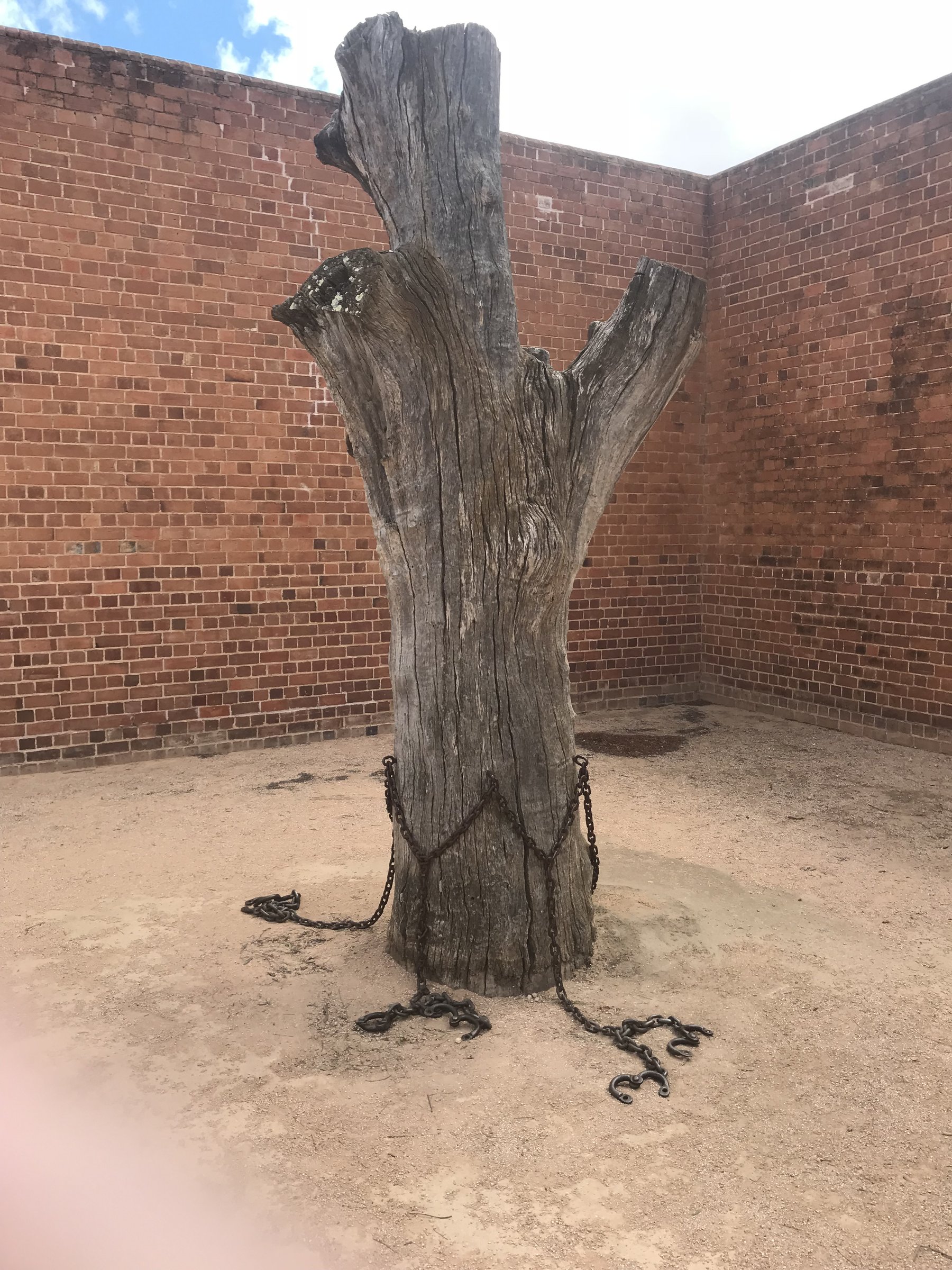
Then came Silverton, out on the Barrier Ranges near where Broken Hill would soon rise, from March 1886.10 This, James said, was where "the chief incidents of his career occurred," in "the wild times on the field."5 Silverton was the original "silver city", near its short-lived peak - it boasted nine hotels, he liked to point out, to Broken Hill's two.12 The records say the Silverton gaol began as a small timber-and-iron structure whose cells opened directly onto the street; prisoners were locked in with leg-irons, and when the place overflowed - as a silver rush will make a lock-up overflow - the overflow were simply chained to a peppercorn tree in the open air. By James's own account the watch-house he kept was still much the same: "an old tin shed" with two heavy logs laid on the floor, to which every lawbreaker was leg-ironed for the night "in the humane fashion of the time." A single candle lit the room. The shanty looked, he said drily, rather too much like a hotel, so that drunken miners "eternally pestered the keeper for a place to be in" and disturbed his peace at all hours.5 It was here, too, that his duty first brought him hard up against a darkness he would one day know from the inside: he arrested a man named Frederick Hodges, charged with attempting suicide. It is the first turn of a thread that runs, quietly and terribly, through the whole of James's life - the constable called to stand between a broken man and his own hand, years before the same darkness came looking for him. And it was here, worn down by the field, that pleurisy and pneumonia knocked him flat and forced him to change his air for four months.5
Forty years behind the explorers
When James rode into Silverton in March 1886, the Barrier country had been on the maps for barely a lifetime. Charles Sturt had named the Barrier Range in 1844, turned back by a wall of stone ridges on his push toward the centre. Sixteen years later Burke and Wills came up the Darling and made their depot at Menindee, a hundred-odd miles to the east - the last outpost of settled country before they went north and did not come back. That was 1860; James took up his post twenty-six years afterwards. Men were still alive in the district who had watched the explorers' camels file past, and the stock routes and mail tracks he rode as a constable were, in many cases, the explorers' lines of march, worn in afterwards by pastoralists and then by the silver rush. It is worth holding that in mind when reading of leg-irons and a tin shed. Silverton was not a quaint old town. It was the frontier, and James was policing it while the frontier was still open.12
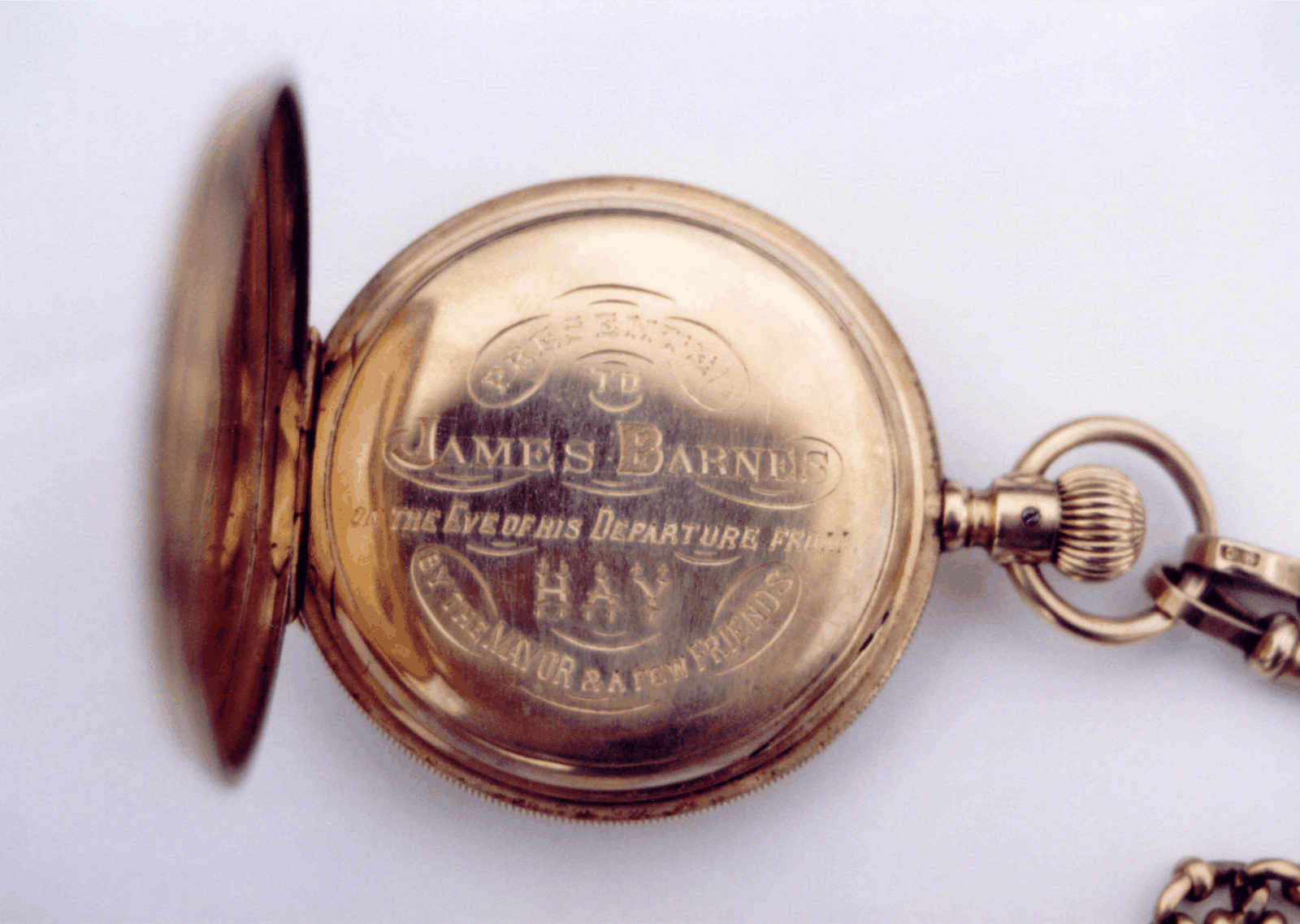
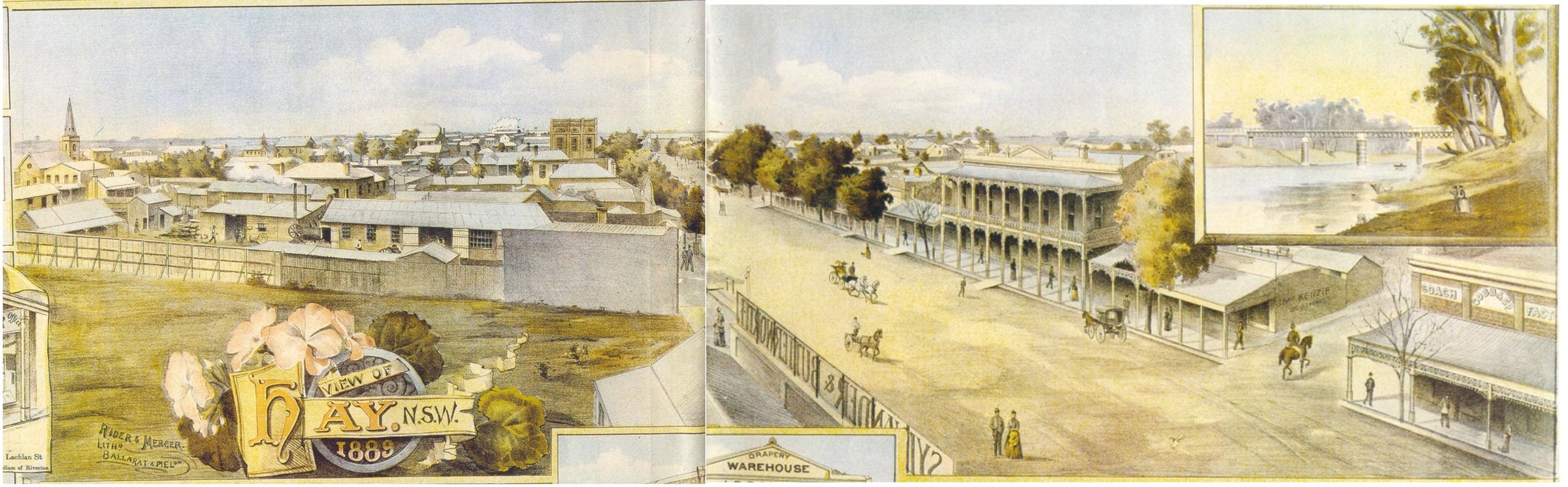
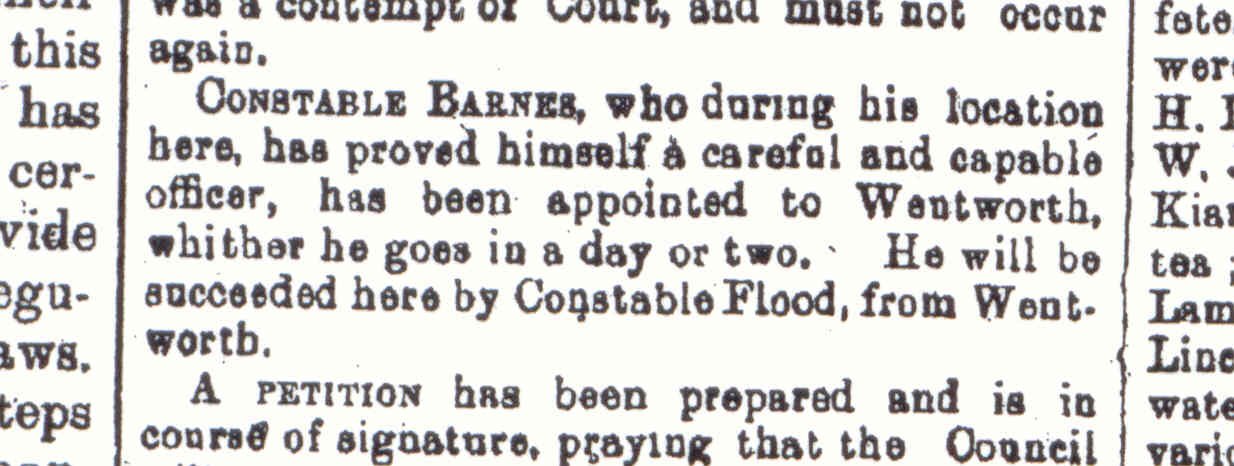
After Silverton came three and a half years at Hay, from January 1887 to May 1891.10 Hay was a hard, hot town where the Murrumbidgee met the great treeless plain; Cobb and Co. ran a coach factory there, and the coach roads struck out for hundreds of empty miles in every direction. A large part of James's work was escorting gold and prisoner coaches over those distances - his biggest single job, he remembered, was taking a coach of criminals from Tarcutta to Silverton, two hundred and fifty miles.13 It was at Hay, too, that he produced the bitten ear in court, a story good enough to run in the papers. And when he left Hay in 1891, the Mayor and a few friends presented him with an inscribed gold Waltham hunter watch, "on the eve of his departure from Hay" - a small, solid mark of a country town's regard for a well-liked officer, and an object that would pass down to his only son.14
Chapter 4. Kangaroo Gully
❧
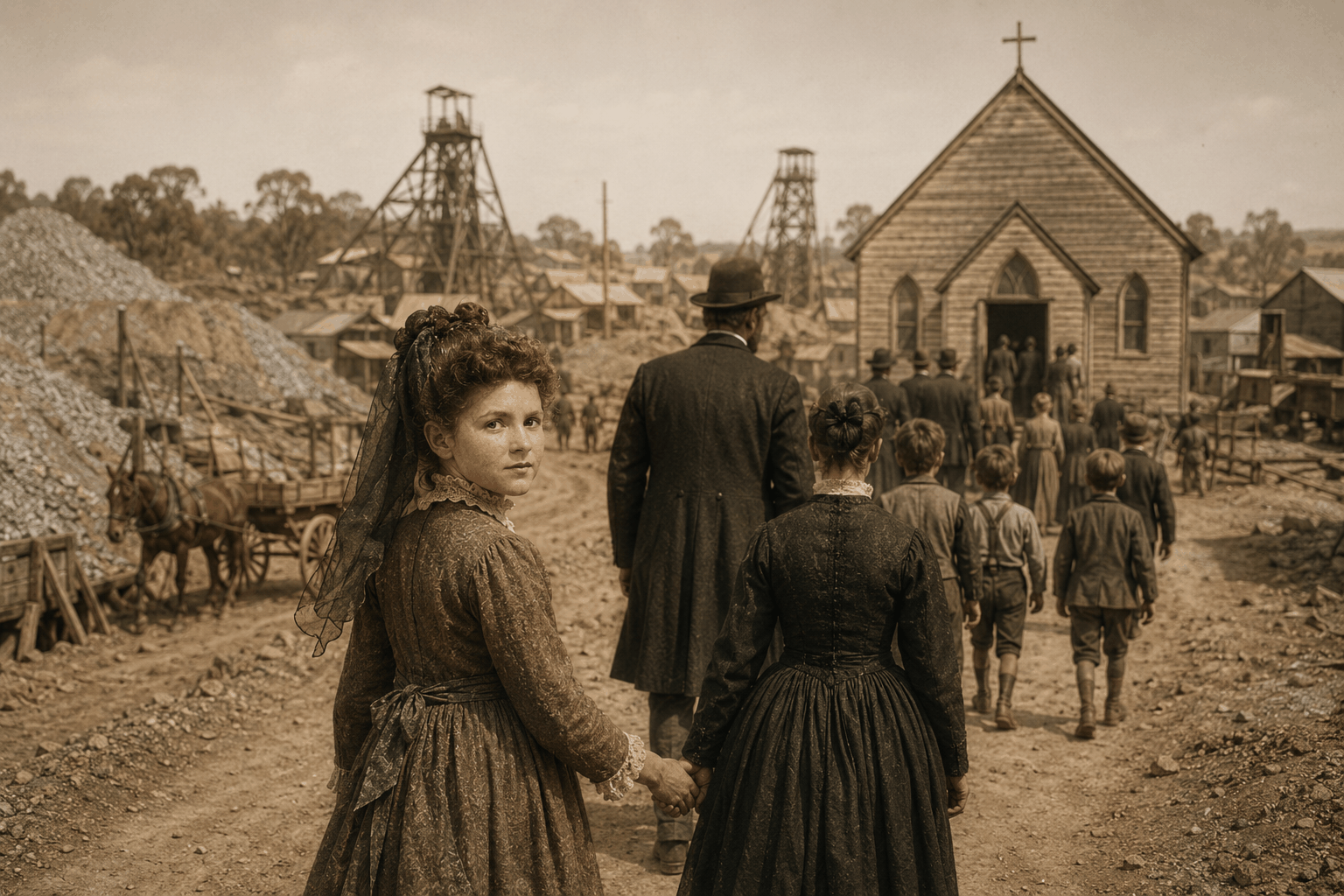
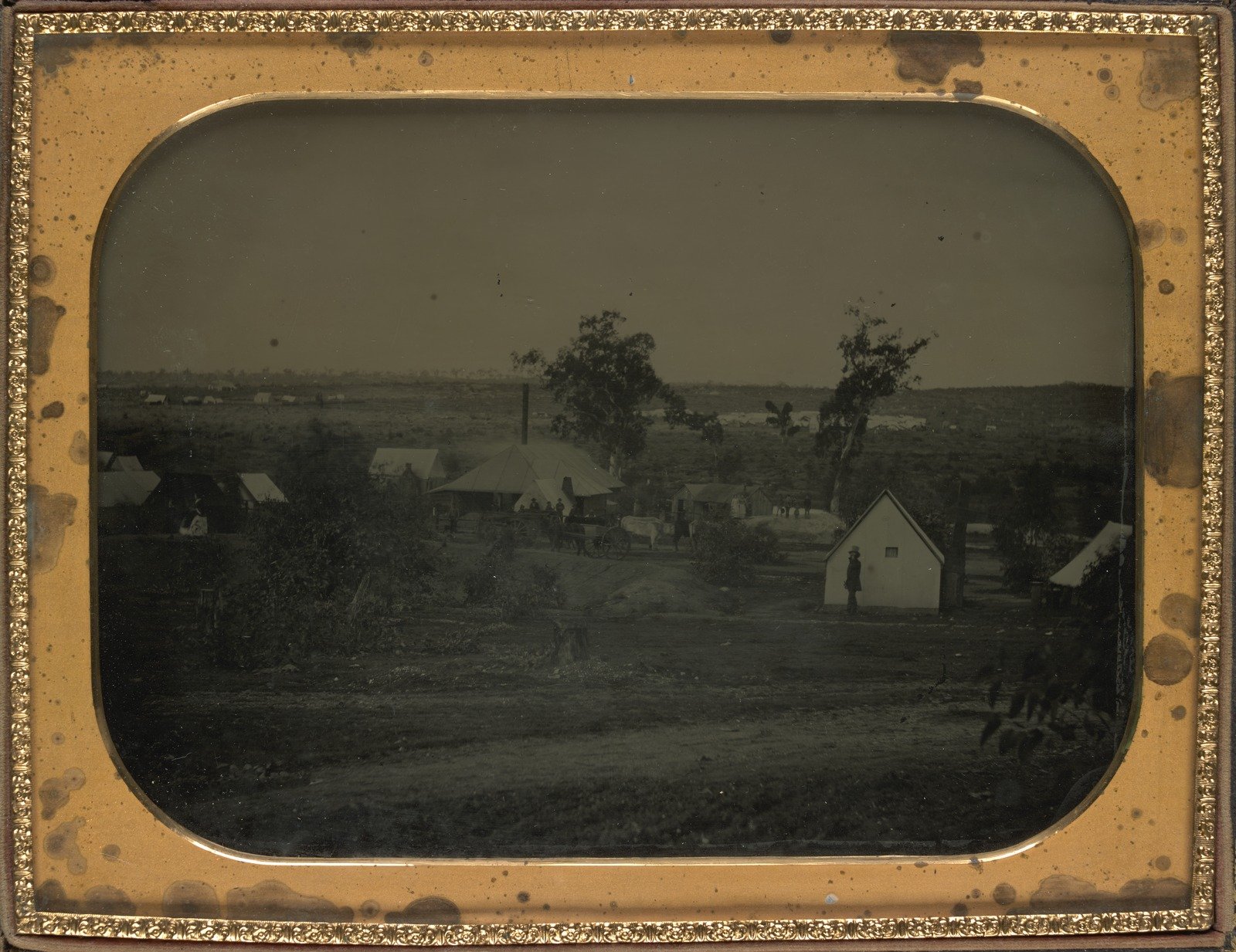
It is a bright Sunday morning about 1875, at Kangaroo Flat, one of the goldfield camps spread out below Bendigo in Victoria. Emily Borrman, about ten years old in her one good dress, walks with her family toward a plain timber chapel, threading between the tall poppet-heads and the pale grey mullock heaps of the deep-lead field.
Even on the Lord's day the field never quite falls silent. The air smells of dust and dry eucalyptus and horse, and underneath it the faint sulphur tang of the crushing batteries that thump away six days out of seven and only just now have stopped. Her father, Theodore, walks ahead in his good coat and his stiff collar - a Silesian miller's son who came halfway round the world to this raw place, and who still speaks his English with the slow roll of the old country in it.
Inside the chapel it is cool and close and smells of pine and candle-wax. The hymns, when they come, are sung half in German, the older voices leading. Emily knows the tunes far better than the words; she mouths the ones she can and hums the rest. Beside her, her mother Keziah stands with her rough, work-worn hands folded - a woman who came out from England as a girl, who cannot read a word of the hymn-book or anything else, and who signed her own marriage lines, years ago, with a plain cross.
Emily is one of a long row of brothers and sisters filling the pew. There is not much money in the house, and not much fuss, and no time for either. But there is chapel on Sunday, and thrift the other six days, and a kind of steady German order laid over the wildness of the diggings.
❧
So far this has been James's story. It is time to bring in Emily, because for the next twenty years it is hers too, and because a woman who survives in the records mostly as a name on her husband's certificates deserves to be met in her own right. Emily Keziah Borrman was born on 12 November 1864 at Kangaroo Gully, one of the goldfield camps that later became a suburb of Bendigo, then called Sandhurst.16 Where the record is thin, as it is for a poor goldfields girl, we build carefully on what a childhood like hers would have been, and we say plainly when we are doing so; nothing here is invented.
A Lutheran childhood on the German goldfields
The Germans were among the most visible groups on the Bendigo diggings. As the alluvial gold gave out in the 1860s, they drove the deep quartz reefs and settled for good, keeping their own Lutheran chapels, their language and their large, thrifty households. This was Emily's world: a chapel-going, German-speaking home on a raw goldfield, a father who read his Bible in German and a mother who could not read at all.17
Bendigo was one of the richest goldfields on earth. When the easy surface gold ran out, it was the German miners in particular who stayed and drove the deep quartz reefs hundreds of feet down, and they built a settled world of their own around the diggings - Lutheran chapels, singing clubs, and large, hard-working families.17 Emily's father, Carl Heinrich "Theodore" Borrman, was one of them: a miller's son from Steinseifen, in Silesia, who came out to Melbourne in 1849 - storm-driven in, the family story goes, by way of Portland - and worked the Victorian goldfields as a carpenter and mining man. He was a devout Lutheran, and it mattered: he and Keziah had married by a Lutheran rite at Thomastown in 1855, and the faith ran through the household.18
Her mother, Keziah Tilley, had come the other way, out from Chippenham in Wiltshire as a young Englishwoman in 1854, in the last age of sail. She could neither read nor write, and signed her marriage with a cross.19 So Emily grew up between two worlds at once - a German-speaking, chapel-going father and an English, unlettered mother - and here lies the quiet riddle of her life. She was born into a devout Lutheran family, yet she would marry James in the Church of England in 1891, and be buried by the Church of England in 1908.20 Somewhere between the German chapel of her girlhood and the English church of her marriage the language softened and the church changed; the records mark the two ends of that journey plainly enough, and we leave the middle of it where it belongs, unguessed.
Like a great many young women of her background, Emily "left home, probably looking for work."21 Domestic service was the usual road for a girl of the diggings with no money behind her: long hours, board in the employer's house, low pay, and a blurred line between family and staff. It took her a long way from Bendigo - north across the colonial border to Wentworth, where the Murray meets the Darling, and where her brother Edwin ran a business.22 There, in service in the busy river town, she met the constable who had once policed its streets.
Chapter 5. Wentworth
❧
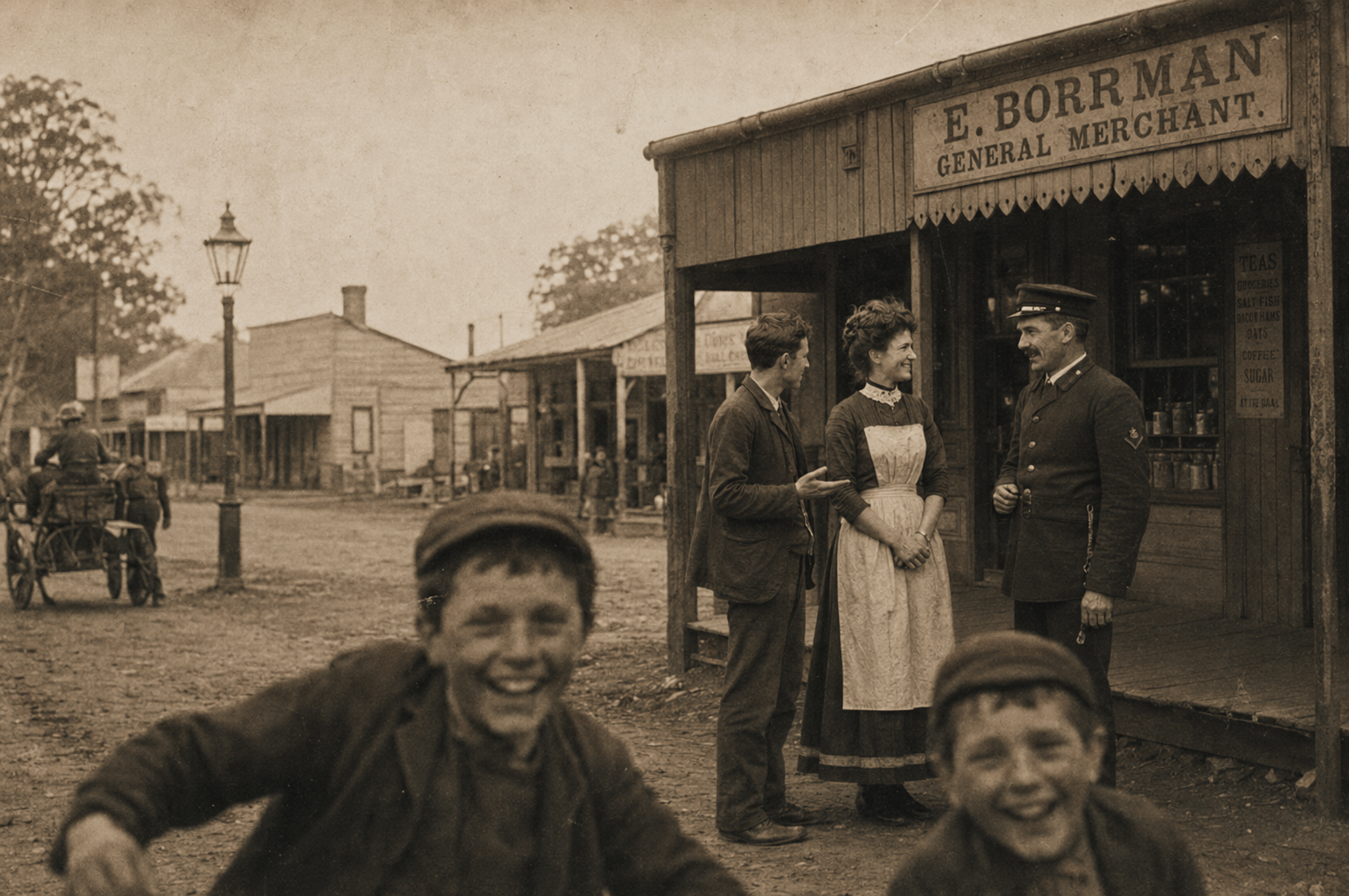
It is spring, 1891, on Darling Street, Wentworth. The spring sun hangs over the town. Paddle steamers sit at the river wharves, and drays move slowly along the street, raising dust as they pass the shops, hotels and businesses.
Outside her brother Edwin Borrman's business, Emily pauses in conversation before setting off on an errand across town. She notices a policeman approaching along the street. Constable James Barnes is on his beat - thirty-seven years old, broad-shouldered and confident in uniform. He has only recently arrived back in Wentworth, though already many locals know his face.
"Constable Barnes," Edwin calls. "Good morning."
Barnes stops and smiles. "Mr Borrman."
The two men had met the previous day. Edwin gestures toward his sister. "You haven't met my sister Emily."
Barnes removes his hat politely. "Miss Borrman."
"Constable," Emily replies.
For a moment they exchange the ordinary pleasantries of strangers meeting for the first time.
"Now where is that accent from, Constable Barnes?" Emily asks.
"The north of England. Have you heard of Kendal? A tad cooler and greener than here, you might say."
The three share a laugh.
"When you're free one evening, Constable, you should join us for dinner," Edwin offers.
Barnes hesitates only briefly. "Thank you. I'd be pleased to."
He touches his hat again and continues down Darling Street. Emily watches him go before turning back to her brother.
Neither can know that within a few months they will be standing together at the altar of St John's Church. Nor that almost everything that follows in this story will begin here.
❧
James came back to Wentworth in May 1891, transferred up from Hay, and this time the river town gave him a wife.10 He married Emily at St John's Church on 21 October 1891 - he a police constable of thirty-six, she a domestic servant of twenty-six.20 Wentworth in the 1890s was the busiest inland river port in Australia. It stood at the meeting of the Murray and the Darling, and the trade of half the back country came through it: some ninety paddle-steamers worked the Darling, and more than four hundred craft used the port in a single year - thirty-one steamers were counted tied up in one week in 1890.23 The wharf was the beating heart of the place, bullock teams hauling wool down to it out of the dry country. It was a busy, rough, transient town, and it kept its constable busy: James's name heads the list of Crown witnesses in more than one Wentworth court case in these years. He was made a first-class constable in March 1892, and the family settled into the police residence and lock-up on Darling Street, right in the thick of it.24 He was a hard man to miss on that wharf - six feet three inches in his boots and something near eighteen stone, "not a finer built man in the whole district," as they would one day say of him.40 And out here the river was the only real road. There were no rail lines into this corner of the colony and few made roads worth the name; to reach the up-river towns and the far outstations a Wentworth policeman travelled as everyone travelled, by paddle-steamer, working slowly up the winding brown Darling toward Menindee and beyond when a court, an inquest or a prisoner escort called him inland. The town's whole living, and much of his work, came and went on the water.23
It was a hard decade as well as a full one, and the hardness came from the wider world as much as from the town. The 1890s were the years of Australia's worst depression: banks crashed, wool and wheat prices fell, and the long peace between the working men and their masters broke down into the great strikes. In 1892 it broke at Broken Hill. The silver field erupted when the companies cut the miners' terms, and hundreds of police were sent to hold it - James among them, one of some three hundred.25 He was in the very first batch of fifty troopers sent up, carbines and all, to hold the field against thousands of angry men. It was there he first met two officers whose names stayed with him for the rest of his life - Mitchell, later Superintendent at Bathurst but then only a senior-constable beside him in the line, and Sherwood, who came up from Sydney as a sergeant with a relief of a hundred men. Until that relief arrived the fifty of them lay out in trenches scraped into the bare hill above the field, and "suffered keenly from the cold during the three days and nights in the trenches on the hill before the relief came." He called it, in his flat way, "perhaps the most stirring time" of his career. After six months of strike duty he came back to Wentworth.5 There is something to notice in that posting: a farmer's son from a settled English valley, sent to dig in on a bare hill against striking miners in the name of the companies and the law. He did not choose the quarrel; he was the law, and the law went where it was sent.
The wider world reached the family in harder ways too. While James kept the peace on the Darling, his youngest brother, Anthony - the baby of the Garnett House household, born in 1870 - had gone soldiering to the far side of the globe. Anthony had joined the Cape Police in South Africa, and when the Second Boer War came he was one of a small, badly outnumbered force that held the town of Kuruman under siege for weeks before it fell on New Year's Day, 1900; he was taken prisoner by the Boers. Word of it reached Wentworth in a letter that the family kept - one Barnes brother a mounted constable on an Australian river, another a prisoner of war on the African veldt, the two ends of a single Cumbrian farm family flung right across the Empire.44
Consumption - the White Plague
Tuberculosis, the "consumption" of the old certificates, was the great killer of the nineteenth century - roughly one death in four. Its cause was found in 1882, but there was no cure: only rest, fresh air and food, and a heavy stigma of poverty and contagion. Emily carried it for some fifteen years, and it shaped the whole household - her returns to Bendigo, her sister moving in to nurse her, and, in the end, her early death at forty-three.29
Meanwhile the family grew. Constance came in 1896, then Cecil in 1897 - born back at the family's Kangaroo Flat, for Emily went home to her mother's country in Bendigo for that confinement. Freda followed in 1900, and the twins, Myrtle and Ivy, in February 1902.26 But a long shadow lay across all of it. Emily was ill. Her death certificate would later record some fifteen years of tuberculosis - the "consumption" that was the great killer of the age - which means the disease was already in the house within a year or two of the wedding.27 As she weakened, her younger sister Lavinia - "Vene" - came to live with the family and help, arriving about the time the twins were born, and never really leaving.28 The strain of it all - a sick wife, a house full of small children, the isolation and grind of a policeman's life, the years of it with no end in sight - gathered quietly through these years. And in January 1902 it broke.
❧
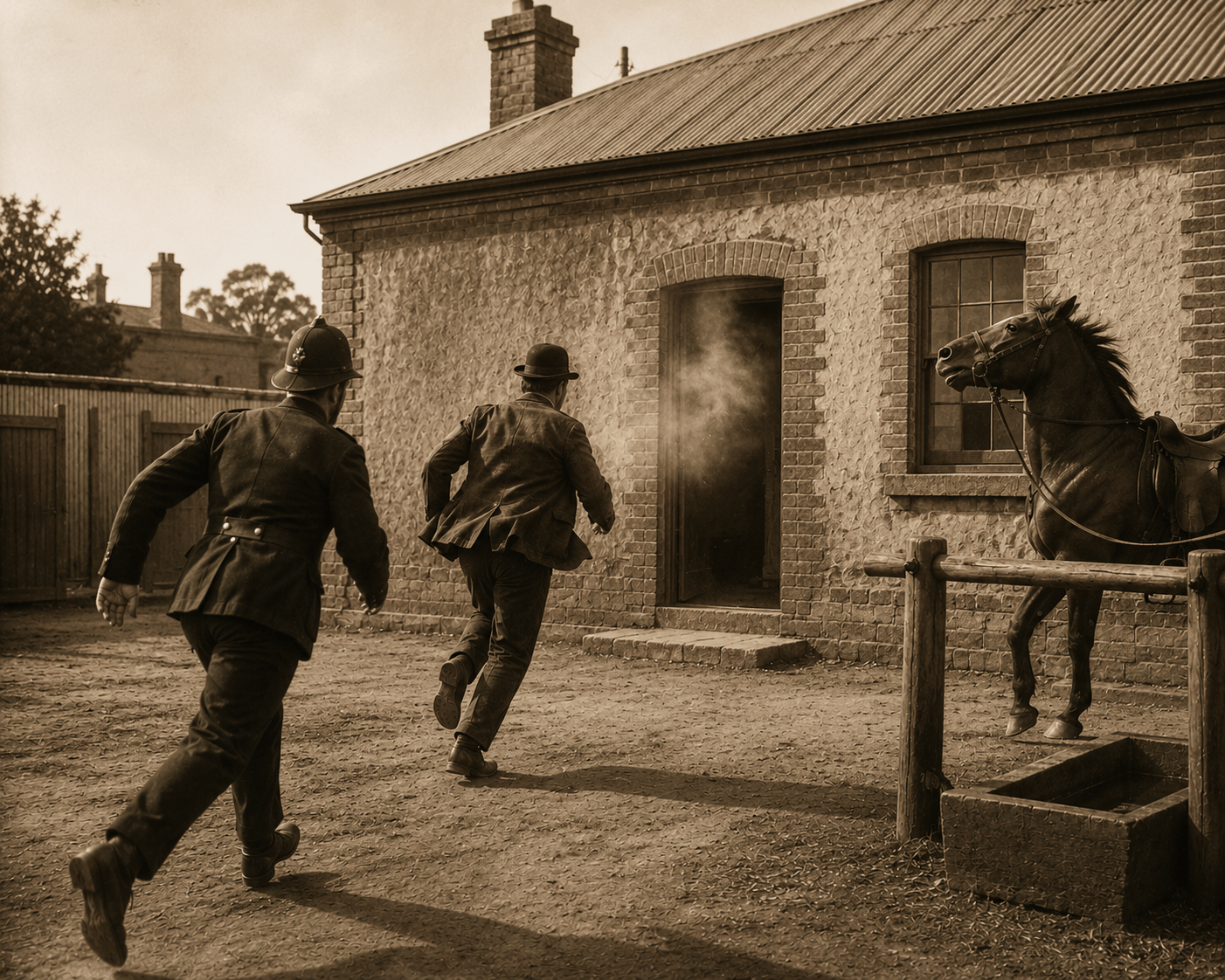
It is the morning of 29 January 1902, at the Wentworth lock-up quarters. A revolver shot cracks across the lockup yard.
"What was that?" Constable Lucas shouts.
Senior Sergeant Bear is already moving. "Barnes's quarters," he says. "Come on!"
The two men run towards the building. Inside they find Constable James Barnes alive but badly wounded, blood running down the side of his face. The revolver is still in his hand.
"Jim," Bear says carefully, holding out a hand. "Give me the pistol."
"Stay back," Barnes replies.
"You're hurt."
"I said stay back."
Lucas takes a step forward. Barnes raises the revolver. "Another step and I'll shoot."
The room falls silent.
"Jim," Bear says quietly, "nobody wants that."
"It doesn't matter," Barnes answers. "I might as well go now as later."
"Think about the children."
Barnes stares at the floor.
For nearly an hour Bear tries to reason with him. The summer heat presses against the walls. Sweat runs down the men's faces. Again and again Bear speaks. Again and again Barnes refuses to surrender the weapon.
Finally Bear glances towards Lucas. A slight nod. Lucas understands. Moving quietly, he slips away and circles towards the front entrance with local resident G. A. Sharman.
Bear keeps talking. "Jim, listen to me. Hand me the revolver and we'll sort this out."
The front door begins to open. A hinge creaks. Barnes's head snaps around. "What was -"
Bear lunges. The two men crash together. The revolver discharges as they struggle. Lucas and Sharman rush in. "Grab his arm!" "I've got him!"
At last the revolver is torn free. Bear steps back, breathing hard, the weapon in his hand.
"Call the Doctor," he cries.
❧
.jpg)
Chapter 6. The Quietest Place I Ever Struck
❧
It is a raw, frosty morning about 1907, before the sun is properly up, at the Kelso police residence on the Sydney Road. There is a knocking at the door. Little Ivy, always a delicate child and often kept home from school in the cold, watches from the passage in her nightgown as her father, in his shirtsleeves, goes to answer it.
Two nuns from the convent across the road are standing on the step, their breath steaming in the grey air, their habits pulled tight against a wind that has come straight off the frost. They are wringing their hands.
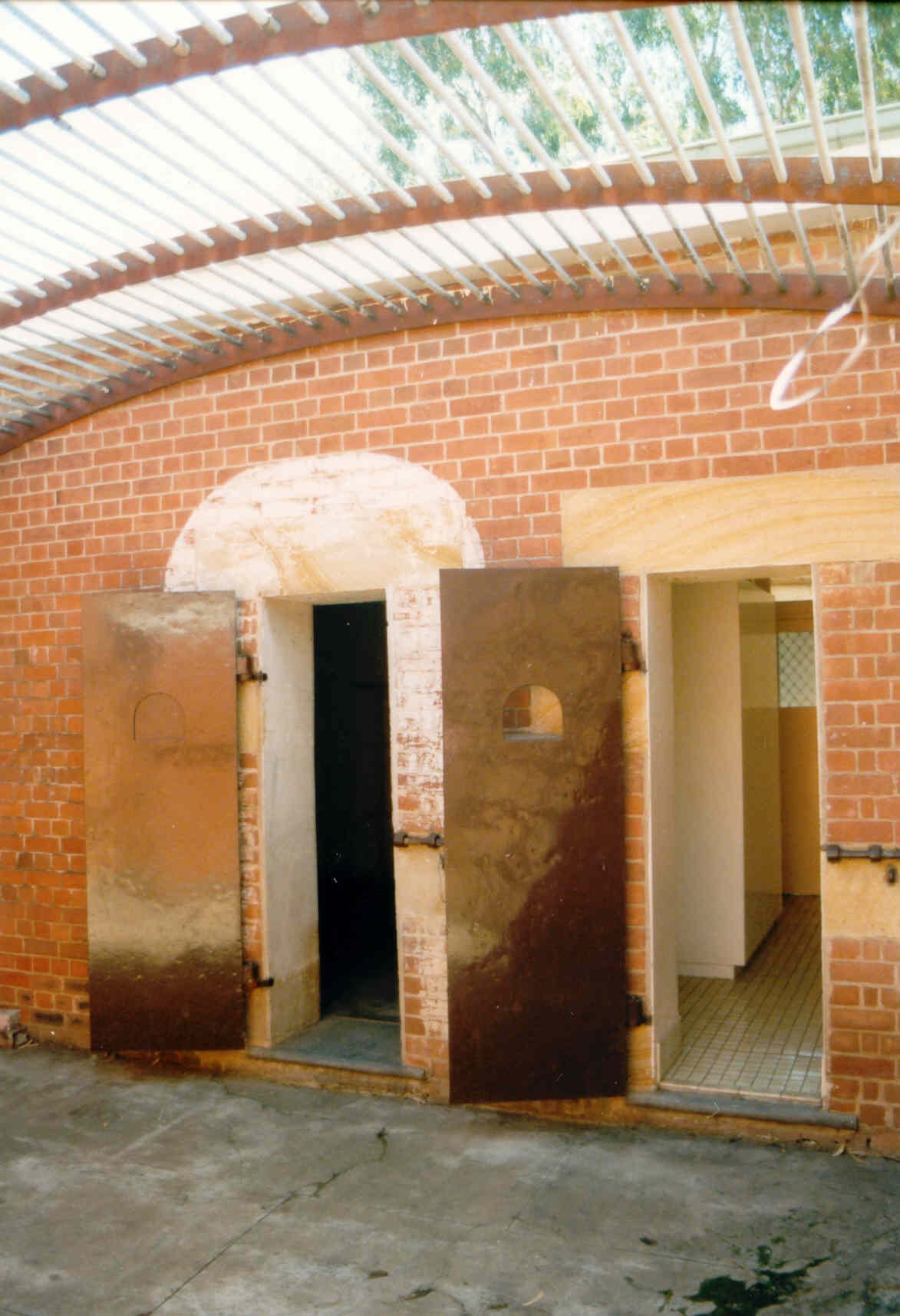
There is a small difficulty. The night before, Constable Barnes had lodged the local woodcutter in the cells for being drunk and disorderly - a rare event in Kelso, whose lock-up the newspapers liked to say had "stood idle for ten years." What nobody had reckoned on was that the same woodcutter cuts, splits and keeps all the firewood for the convent, and the sisters, across the road, are slowly freezing.
"Constable Barnes," says the elder of the two, with great dignity and chattering teeth, "we are fairly perishing over there. Might you see your way to letting the poor man out - just long enough to bring us our wood?"
James looks at the two blue-cold nuns, and thinks of the snoring woodcutter in the cell, and weighs the majesty of the law against a cold breakfast for a house of religious women. It is not a close-run thing.
He lets the man out.
❧
In his retirement speech James skated over these years in a single line - "transferred from the back country to North Sydney in 1901, and in 1906 he came to the quiet village of Kelso."5 His service card tells the fuller, truer story, and it is worth setting straight.10 The transfer to the Metropolitan district at North Sydney came in March 1902, just weeks after the crisis - and here is the kindest reading of a hard time. A constable who had shot himself might ordinarily have lost his job. Instead the force moved James quietly to the city, kept his rank and his pay, and let him serve on. Read alongside the town's reinstatement petition and the gentle press, it looks far less like a punishment than a protection: the force, and the community, closing quietly around a well-liked man to carry him through his worst. The Wentworth paper, the Federal Standard, spoke for the whole town: Constable Barnes, it wrote, was "one of our most popular citizens, respected and esteemed by all who knew him, a man whose kindness and forbearing nature saved many a trouble in Wentworth" - a man "so well liked here that a hint of his removal at any time would have been met with stout opposition from each and every resident."30
He stayed in the Metropolitan district about four years.10 It was there, in the city, that the family met its next sorrow. The elder twin, Myrtle, took ill while she was teething; she went into convulsions, and no one could help her. She died at about a year old and was buried at North Sydney - the "one female deceased" who would appear, unnamed, on later family certificates, a small grave a long way from anywhere the family would live again.28
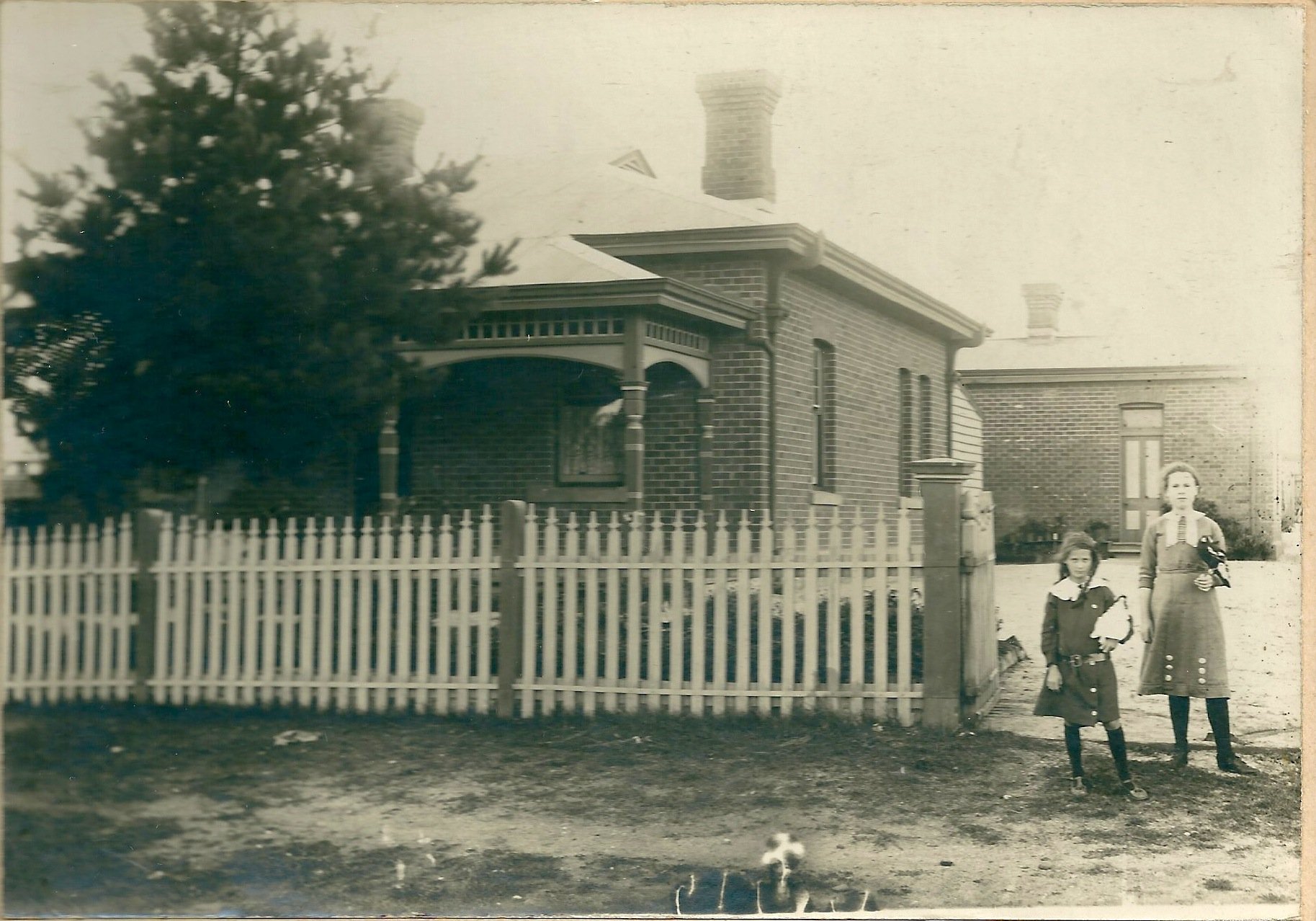
Then, early in 1906, James came out to the central west. The service card shows him briefly at Blayney, and then at Cowra, both short postings in the space of a few months.10 He had come to the district; and when the vacancy at Kelso arose he took it. In September 1906 he was appointed - on promotion - to the little village across the Macquarie from Bathurst, and into the quietest beat of his life.31 Kelso was a village, but only the river separated it from Bathurst, Australia's oldest inland town and the capital of its first gold country; much of James's actual work was done over there, in the Bathurst courts. A councillor once grumbled that the Kelso officer was "on duty in Bathurst all his time, even on Sundays."32
The Kelso beat was famously idle. Only the Macquarie River separated the little village from Bathurst - Australia's oldest inland town, the capital of its first gold country - and much of James's real work was done over the bridge, in the Bathurst courts. The Kelso lock-up itself had "stood idle for ten years except as a dwelling house for the local police officer," the papers joked, until James "beat the record" one Saturday night in May 1908 by lodging a man named William Eddy, found very drunk on the roadway.33 Ever since the railway had reached Kelso in 1875 the resident constable's daily duty was to walk down and meet the morning and evening trains and see who got off into his patch; that, a few unregistered dogs and the odd out-of-season duck, made up most of the crime in the quietest place he ever struck.33
These are small stories, but they are the truest picture we have of the man at home, and they show the times as much as the man. His daughter Ivy remembered him as a "mighty pen man" - careful, thorough, a fine hand with a pen - who checked the children's homework at the kitchen table and made them do it again, neatly, if it was not right, on pain of a rap on the knuckles. His only son, Cecil, raked the white pebbles round the police station smooth every morning before school, ready for inspection. One day James and Cecil came home from shooting with a brace of rabbits and James told the boy to clean and gut them; Cecil answered back, "do it yourself" - and got a hiding with the dead rabbits for his cheek, and a spell in the Kelso cells for good measure, from which, the family laughed for years, his arms were just long enough to reach out through the bars and let himself out again.28 It is a small, warm, everyday picture of a big, quiet man keeping a firm and loving order in a house full of children and trouble.
The country policeman's wife
The police annals cast the wife of a country constable as a figure of "great fortitude and courage" - nursing the sick, comforting the grieved, and keeping a household together on a constable's pay through isolation and frequent transfers. She lived wherever the force sent her husband, usually in the residence attached to the lock-up, and packed the whole house up every few years to follow him to the next town. It is the role Emily filled across Wentworth and Kelso through fifteen years of consumption, and the one her sister Lavinia stepped into from the twins' birth as Emily's health failed.15
And there was trouble enough. It was a gentle place to have set down a battered man and an ailing family, but the shadow had come with them from the river. Emily had been ill for the best part of fifteen years by now - consumption, the slow wasting disease that had shadowed the whole marriage. Through all of it she had kept a policeman's house on a policeman's pay, borne five children and buried one, and followed her husband from posting to posting across half the colony: Wentworth, then North Sydney, then Blayney and Cowra, and now Kelso. Her younger sister Lavinia had come to nurse her and never left. On 3 June 1908, at the Kelso police residence, Emily died, aged just forty-three.27 She was buried the next day in the Holy Trinity cemetery, her coffin carried by her husband's fellow officers under Senior-Constable Meagher, the "Dead March" played over her.34 James had lost the goldfields girl he had met on Darling Street, in the quietest place he ever struck.
Chapter 7. This Is Heaven
❧
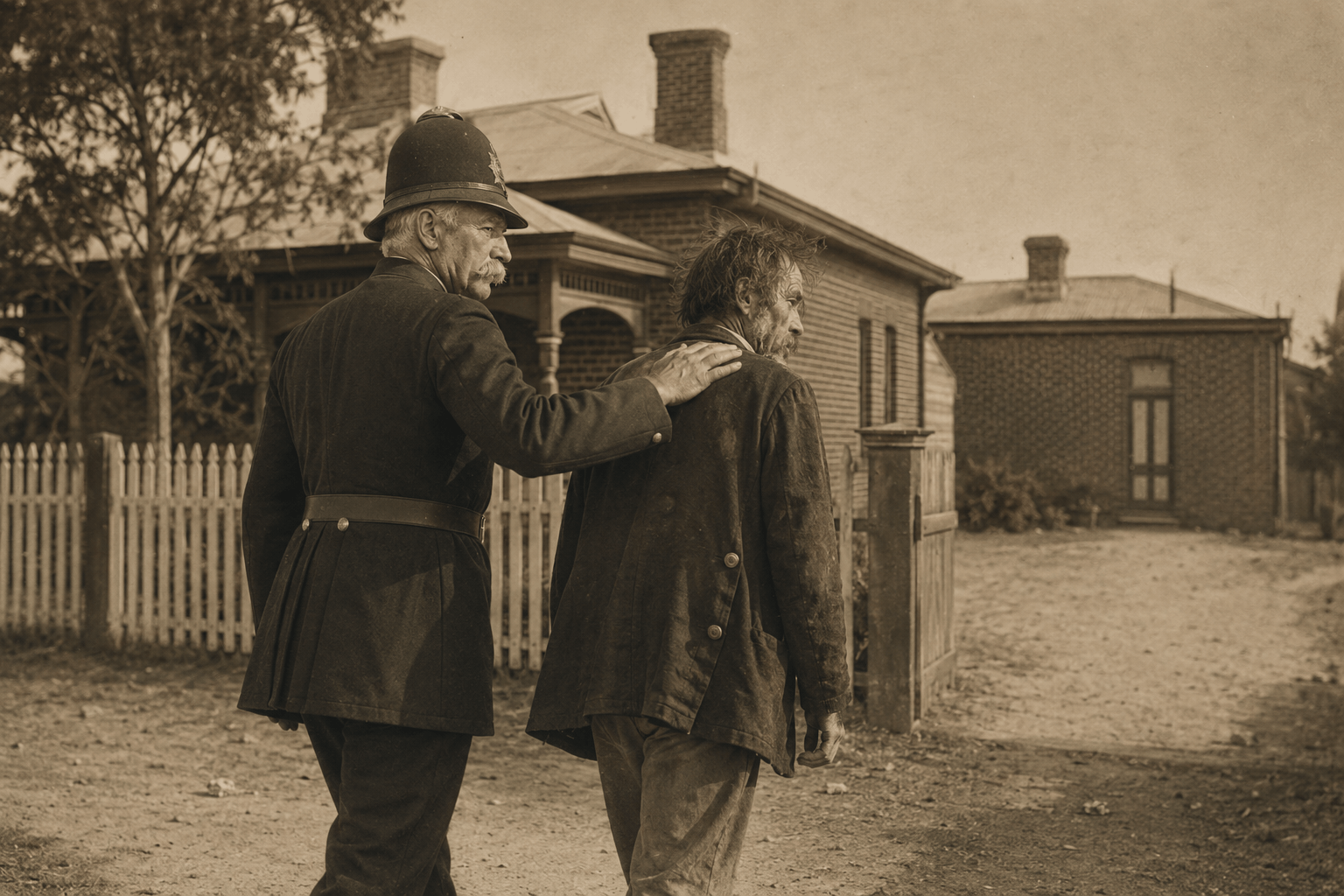
It is a hot afternoon on 30 January 1911, on the dusty Sydney Road at Kelso, and Constable Barnes is walking a stranger to the lock-up.
He does it slowly. The man beside him is thin and wild-eyed, his coat buttoned wrong, and he keeps stopping to look back over his shoulder at nothing. His name, they will find out, is Alexander Patterson, and he has been found wandering the road out of Bathurst, frightened of the air itself. The gum leaves hang still in the heat. A magpie carols somewhere and the man flinches at the sound of it.
"They told me to kill myself," Patterson says, low and fast, as though sharing a terrible secret. "They've been at me for days. They've stolen my brains, Constable. Took them clean out."
James does not argue with him. He does not tell him to pull himself together, or hurry him along, or laugh. He simply walks at the man's pace, one big hand resting light on his shoulder, steering him toward the little cells where he will be safe and warm until the doctor can come out from Bathurst.
Because James knows exactly where this man is standing. Nine years ago, in a locked room at Wentworth - a sick wife in the next room, two new babies, a revolver in his own hand - he had been at that same edge himself, and it was another patient man, talking low and steady for the best part of an hour, who had brought him back from it.
He came back from that place. Most did not; perhaps Patterson will not. But James Barnes, of all the constables in the western district, is the one man who can walk beside him without fear and without judgement, because he has walked that same road himself, and lived to reach the far end of it.
"Come on now," he says gently. "We'll get you out of this sun."
❧
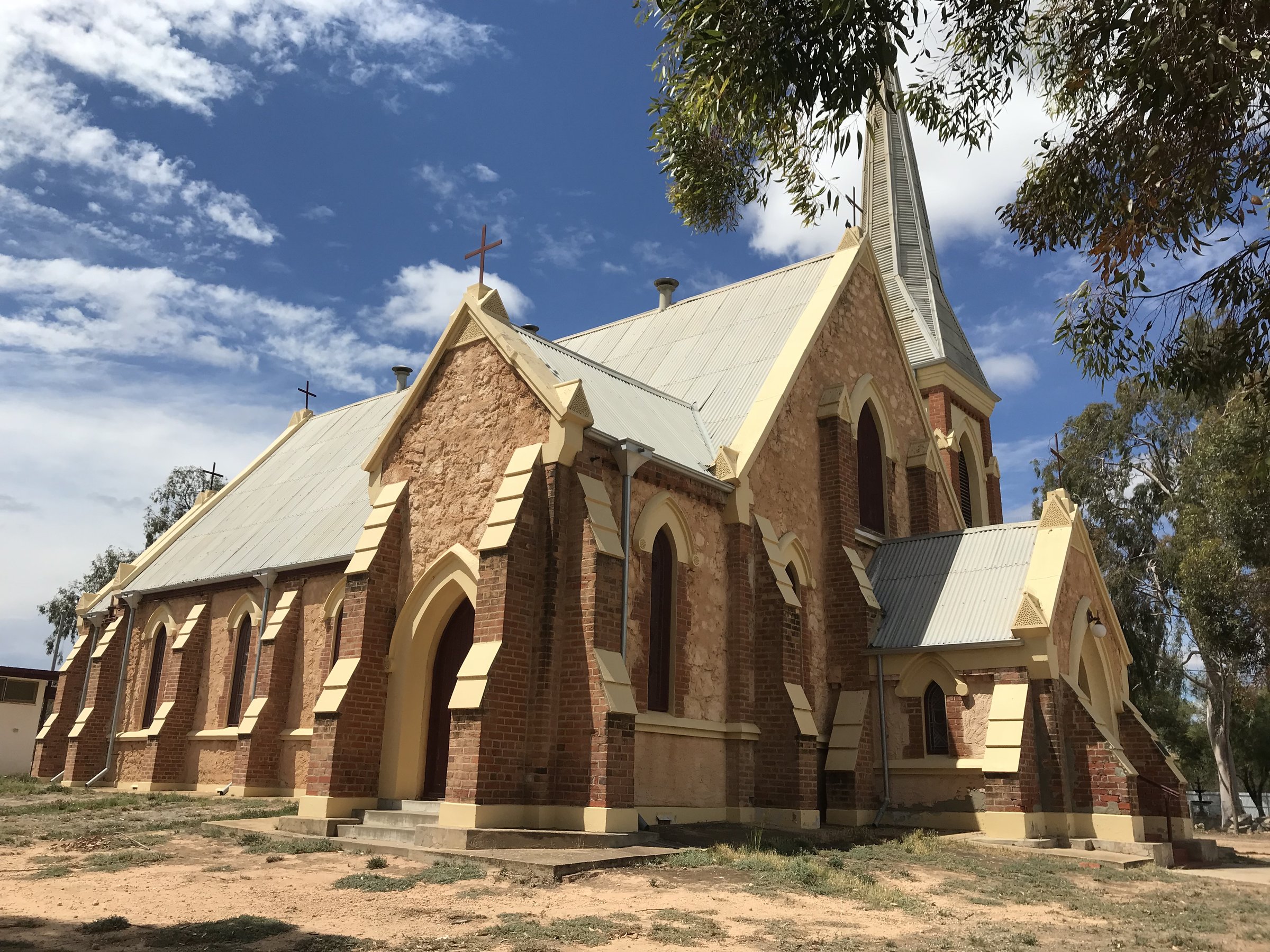
The last years at Kelso were, for the most part, good ones. In January 1909 James's father, Anthony, died back at Selside, aged eighty-seven, and left James a share of a comfortable Cumbrian estate - £100 in cash, ten Lancaster Banking Company shares held in trust, and an equal fifth share of the residue alongside his brothers and sisters.35 The tenant's son had done well by his father in the end. And in 1910 James made a decision the family would talk about for generations: he married Emily's younger sister, Lavinia.
To understand the marriage you have to understand the years behind it. Lavinia - "Vene" - was Emily's younger sister, a good nineteen years younger than James. She had come to the family about the time the twins were born in 1902, to nurse her failing sister and help with the babies, and she had stayed. For the last six years of Emily's life the three of them shared one roof and one long ordeal: the slow dying in the back room, the house full of small children, the transfers from town to town, the worry that never lifted. James and Lavinia nursed Emily together, grieved for her together, and raised her children together, side by side, for years before there was ever a question of a wedding. When they married in 1910 it was less the beginning of something than the quiet naming of a life they had already been living - two people bound by the same long trouble and the same affection, who had earned their plain happiness the hard way.
The marriage the church refused
Marrying a deceased wife's sister was a live controversy for a century. New South Wales legalised it in 1875, well ahead of England, which held out until 1907. But the Church of England still would not perform such marriages on its own canon-law grounds, so couples in James and Lavinia's position simply married in another denomination - which is exactly what the certificate shows them doing, and what the family remembered as "turning Baptist."36
There was a hitch, and it is a revealing one. New South Wales had made it lawful to marry a deceased wife's sister back in 1875, decades ahead of England - so the union was perfectly legal.36 But the Church of England, the church of James's whole life, still refused to solemnise such a marriage on its own grounds, and would not perform it. So the couple simply went to a church that would. The certificate records a Congregational minister marrying them at the Kelso police station on 23 June 1910; the family, remembering it more roughly, said the pair had "become strict Baptists."37 Either way the meaning is the same: the church that had married him to Emily would not marry him to her sister, and rather than give up the marriage he gave up the church.
He policed on, a genial, heavy-set figure in a quiet town, and the papers were fond of him. The motor car was just beginning to appear on the Bathurst roads, a marvel and a menace both, and in 1912 the local sheet ran a small joke under the heading "Constable Barnes Does a Sprint", teasing "one of the heaviest constables in the Western district" - six feet three and eighteen stone - who had somehow "caught a motor car last week."5 There was a serious side to the same quiet beat. Now and then his duty brought the old darkness back to his own door - the wandering man in 1911 who cried that voices had told him to kill himself, whom James, of all the constables in the district, knew exactly how to walk gently to the cells and keep safe until the doctor came out from Bathurst.5
He was making ready to stop. In July 1913, with his pension in sight, James did something he had never done in sixty years of wandering: he bought a piece of ground of his own. It was a block on the north side of the Sydney Road, a stone's throw from the police station, and it cost him £300 - a modest place for a modest retirement, but his, freehold, the first land the tenant farmer's son had ever owned outright.47 That October the Bathurst Times noted, in its "Personal" column, that "First-class Constable Barnes, of Kelso, began a six months' leave of absence at midnight last night, after which he retires from the police force with 34 years' service" - and, in the paper's fond shorthand, ran through the stirring career one more time: Broken Hill in the big strike, the shearers' strike of '94, the maritime strike, "in the thick of it" every time.46 On his sixtieth birthday, 31 March 1914 - the compulsory retiring age, to the very day - he was discharged on pension after thirty-four years' service.10 The night before, at the Police Barracks in Bathurst, his comrades gave him three silver-mounted pipes and a walking stick, and, a man of few words, he told them the whole tale of his stirring career.5
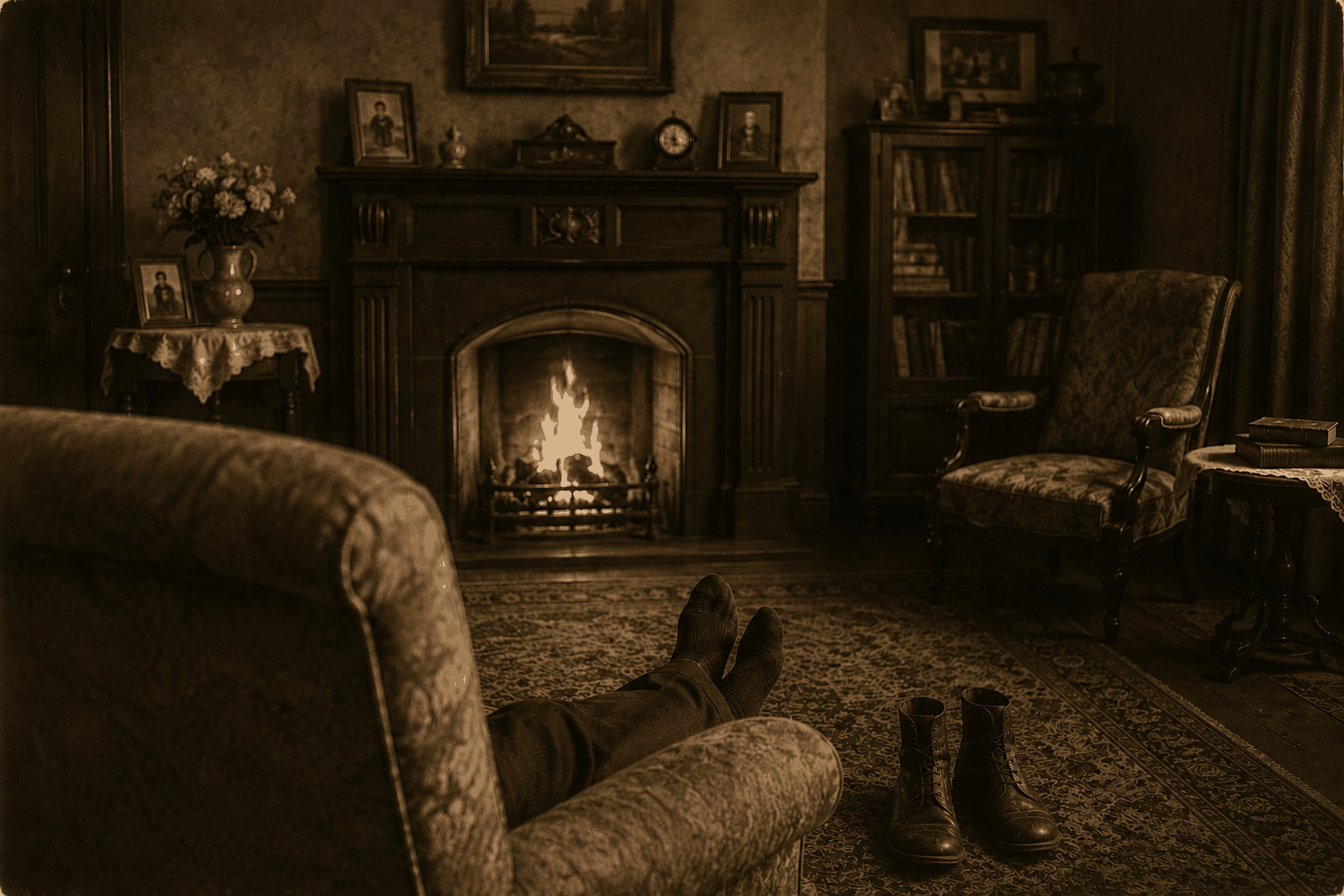
He had just ten weeks left, and he spent part of them on one last errand. Late in the piece he made the long journey down to Sydney to arrange for his second daughter, Freda, to go away to boarding school - a plan she did not want in the least - and it was from that trip that he came home to die. On 22 June 1914 the evening train brought him back into Kelso, and he walked up from the station to the residence a very tired man. The kitchen stood a little apart from the main house, and twelve-year-old Ivy never forgot watching him come in at the door. He told Vene he was worn out, and looked it; she told him to go through and rest in his own big easy chair while she put the kettle on. He pulled off his boots, lowered himself into the chair, and leaned his head back.
His last words, his youngest daughter would tell the family for the rest of her long life, were three:
"This is heaven."
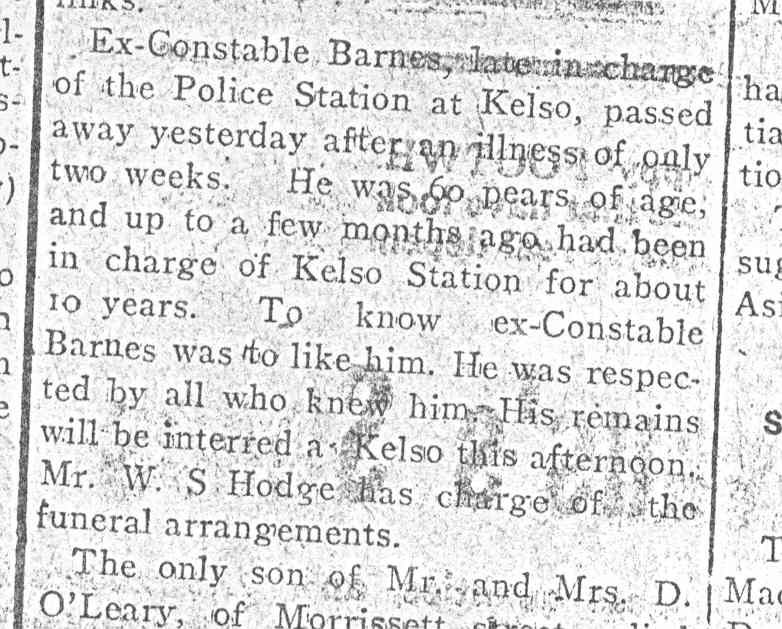
And as he leaned back he was gone - there in the chair, with the kettle not yet boiled and his daughter watching from the doorway. He was sixty, and the cause was set down as acute cholangitis.39 "Everyone that knew the deceased constable knew what a fine stamp of man he was," ran the obituary, "and perhaps there was not a finer built man in the whole district. He stood six feet three inches in height, and weighed 18 stone."40 The next day he was buried in Emily's grave at Holy Trinity, Kelso - the two of them laid together in the one grave, where they lie still - four of his police comrades carrying the coffin and the old hymn "Rock of Ages" sung over the pair of them.38
Chapter 8. After James
James left a small, tidy estate, and it tells you a good deal about the man. When probate was granted in September 1914, the sworn inventory came to a net value of £389 16s 2d in New South Wales.41 It is worth setting out, as a valuer would, because this is exactly what the family were left to work on. There was the Kelso land, valued at £275; fifty shares in the Hill End Amalgamated Gold Mine, worth a modest £6 5s - the last thread of a lifelong tangle with gold; the household furniture; £95 in the Government Savings Bank at Bathurst; some livestock, a carriage, and the harness and saddlery of a mounted man.42 His will left his gold watch and chain - the Hay watch - and his breech-loading gun to his son Cecil.41 Against the assets stood only a few small debts - to a Sydney tea merchant, a Bathurst storekeeper, and a music teacher who had been giving one of the children lessons. A further £266 of English effects, his share of his father's estate, was collected the next year through a grant resealed in England.35
Put together, it came to something like £650 - a comfortable but modest sum, and about a third of the £1,900 estate his own father had left in Cumbria. There is a quiet symmetry in that. The tenant's son who walked away from the settled Barnes farm, who crossed the world twice and gave up an easy place in it, died worth roughly the single fifth-share of his father's estate that he had inherited by post. He had spent his life in motion, and ended it with a horse, a watch, a bank book and a bit of goldfield land.
The estate did not pass straight to the children. Under James's will, Lavinia held it for her lifetime, and only on her death was the balance to be divided among his surviving children. Lavinia lived on until 1939; she sold the Kelso land in 1918 and moved with the family to Bathurst, taking a house in Howick Street, near the theatre.43 So the children did not truly come into their father's estate until a quarter of a century after he died in his easy chair - a long time to wait on a horse, a watch and a bank book.
It is Ivy we have to thank for most of what is warm in this book. In her nineties, half-blind, she told her family's stories down the telephone so that they would not be lost - her father coming in at the kitchen door, the nuns and the firewood, the twin who died, the homework that had to be perfect, the easy chair and "this is heaven." James Barnes let the work speak for him, and was a man of few words to the very end. His youngest daughter made sure the words were kept.

Appendix
Biographies
Barnes, James (1854-1914)
James Barnes was born on 31 March 1854 at Garnett House, Strickland Ketel, three miles from Kendal in Westmorland, the third surviving child of Anthony Barnes, a farmer of some 188 acres, and Margaret Ellwood. The Barnes were several generations of settled Lake District farmers and strong local people; James was named for his uncle, the botanist James Martindale Barnes. He grew up on the land - the 1871 census lists him at seventeen as a farmer's son - but did not stay on it. By his own later account he reached Australia the roundabout way, spending time in New Zealand "travelling about the country" before landing at Sydney on the Hero in 1876.
After about two years in Sydney he joined the New South Wales Police in 1880 and was posted to the Temora goldfield. There, in April 1882, he struck "a good find" of gold and - "with the restless fever in him", as he put it - resigned to make use of it, sailing home toward the north of England; finding the cold unbearable after the colony, he returned within months and rejoined the force at Deniliquin in 1883. A first, short posting then took him to Wentworth in 1885-86 - six years before the river town would give him a wife. The rest was country policing at its hardest: Silverton and the Barrier, where the lock-up was "an old tin shed" and he caught pleurisy and pneumonia; three and a half years at Hay, escorting gold and prisoner coaches enormous distances; and Wentworth, where he was made first-class constable in 1892. He was one of some three hundred police entrenched at the 1892 Broken Hill strike, three days and nights in the trenches - "the most stirring time of his career."
On 21 October 1891, at St John's Church, Wentworth, he married Emily Keziah Borrman; they had five children. In January 1902, under the strain of his wife's failing health and the pressures of the job, he attempted to take his own life at the Wentworth lock-up; he recovered amid much public sympathy and a petition for his reinstatement, and served another eleven years. He moved soon after to the metropolitan district (North Sydney), where he served about four years; then, early in 1906, out to the central west - briefly Blayney, then Cowra - and, when the vacancy arose, in September 1906 to the quiet village of Kelso, near Bathurst. Widowed in 1908, he married Emily's sister Lavinia in 1910; because the Church of England would not solemnise a marriage to a deceased wife's sister, they wed by a Congregational rite at the police station. A Protestant and a well-regarded officer - six feet three inches and eighteen stone - he retired on pension in April 1914 after thirty-four years' service, and died at Kelso on 22 June 1914 of acute cholangitis; his last words, his daughter recalled, were "this is heaven." He was buried with Emily in the one grave at Holy Trinity, Kelso.
Barnes, Emily Keziah (nee Borrman) (1864-1908)
Emily Keziah Borrman was born on 12 November 1864 at Kangaroo Gully, one of the goldfields camps that became a suburb of Bendigo (then Sandhurst), Victoria. She was a daughter of Carl Heinrich "Theodore" Borrman, a Silesian-born miller and goldfields man, and Keziah Tilley, an English migrant who signed her own marriage with a cross. Emily grew up in the German-influenced diggings community and, as a young woman, left home, probably looking for work. She went to Wentworth, at the Murray-Darling junction, where her brother Edwin ran a business, and there she was in domestic service when she met Constable James Barnes.
They married at St John's, Wentworth, on 21 October 1891. Over the next decade Emily bore five children - Constance (1896); Cecil (1897, born back at her family's Kangaroo Flat); Fredricka "Freda" (1900); and the twins Myrtle and Ivy (1902) - of whom Myrtle died in infancy. For much of the marriage Emily was ill: her death certificate records some fifteen years of tuberculosis, the "consumption" that shadowed the household and led her younger sister Lavinia to move in and help. A country policeman's wife through repeated transfers, she kept house on a constable's pay across Wentworth and, from 1906, Kelso. She died at the Kelso police residence on 3 June 1908, aged forty-three, and was buried - with a large attendance of her husband's fellow officers - in the Holy Trinity cemetery. She was of the Church of England, though born to a Lutheran family.
Barnes, Agnes Lavinia (nee Borrman) (1873-1939)
Agnes Lavinia "Vene" Borrman, born in 1873 at Kangaroo Gully, was Emily's younger sister. As Emily's tuberculosis worsened she came to live with the Barnes family, attending the birth of the twins in 1902 and helping to raise them and run the household through Emily's long decline. After Emily's death in 1908 she and James decided to marry; barred by the Church of England from a union with a deceased wife's sister, they married by a Congregational rite at the Kelso police station on 23 June 1910 - a marriage the family remembered as their "becoming Baptists." There were no children of the marriage. Widowed in 1914, Lavinia was executrix of James's estate and, as "Lavinia Agnes Barnes", sold the family's Kelso land in 1918. She died in 1939.
Family Group Sheets
Sheet 1 · James Barnes & Emily Keziah Borrman
Husband
Wife
Marriage
Children
| # | Name | Born | Notes / later life | Source |
|---|---|---|---|---|
| 1 | Constance Violet (m. Redding) | 9 Apr 1896, Wentworth | m. Edgar E. Redding 1919; d. 1974 | S-113 · S-146 |
| 2 | Cecil Howard (m. Gibson) | 14 Dec 1897, Kangaroo Flat, Vic | railway, then A.I.F.; m. Ethel Gibson; d. 4 Dec 1944 | S-081 · S-121 |
| 3 | Fredricka 'Freda' (m. Brainwood) | 2 Feb 1900, Wentworth | missionary; m. Ernest Brainwood 1922; d. 11 Aug 1936, Cairns | S-115 · S-125 |
| 4 | Myrtle (elder twin) | 11 Feb 1902, Wentworth | died in infancy, Oct 1903; buried North Sydney | S-054 · S-121 |
| 5 | Ivy 'Doll' (younger twin, m. King-Davies) | 11 Feb 1902, Wentworth | m. Samuel King-Davies 1922; d. 1999; key family witness | S-053 · S-114 · S-121 |
Sheet 2 · James Barnes & Agnes Lavinia Borrman (second marriage)
Husband
Wife
Marriage
Children
| # | Name | Born | Notes / later life | Source |
|---|---|---|---|---|
| 1 | No children of this marriage | - | - | S-087 |
Sheet 3 · Anthony Barnes & Margaret Ellwood (James's parents)
Husband
Wife
Marriage
Children
| # | Name | Born | Notes / later life | Source |
|---|---|---|---|---|
| 1 | John Ellwood Barnes | 1849 | died 1856 (aged ~7) | S-145 |
| 2 | Agnes Barnes | 1851 | gave James the 1862 Bible | S-001 · S-145 |
| 3 | James Barnes | 31 Mar 1854 | -> Sheet 1 | S-145 |
| 4 | Margaret Barnes | 1857 | - | S-145 |
| 5 | William Barnes | 1859 | England | S-145 |
| 6 | Ann Barnes | 1861 | - | S-145 |
| 7 | Amelia Barnes | 1864 | - | S-145 |
| 8 | Anthony Barnes | 1870 | Cape Police; Boer War POW at Pretoria, 1900 | S-051 · S-145 |
Sheet 4 · Carl Heinrich 'Theodore' Borrman & Keziah Tilley (Emily's parents)
Husband
Wife
Marriage
Children
| # | Name | Born | Notes / later life | Source |
|---|---|---|---|---|
| 1 | Albert Edward | 1856 | d. 1873 | S-147 |
| 2 | Charles Henry | 1857 | d. 1940 | S-147 |
| 3 | Frederick William | 1860 | d. 1922 | S-147 |
| 4 | Rudolph Theodore | 1861 | d. 1878 | S-147 |
| 5 | Emily Keziah (m. Barnes) | 1864 | -> Sheet 1 | S-146 |
| 6 | Arthur Edwin | 1867 | died in infancy 1867 | S-147 |
| 7 | William Arthur | 1868 | d. 1944 | S-147 |
| 8 | Edwin Alfred | 1871 | d. 1925; ran a business at Wentworth (drew Emily there) | S-131 · S-147 |
| 9 | Agnes Lavinia (m. Barnes) | 1873 | -> Sheet 2 | S-147 |
| 10 | Wilhelmina Henrietta 'Min' (m. Musgrove) | 1877 | m. W. R. A. Musgrove (James's brother-in-law) | S-147 |
| 11 | Violet May | 1880 | d. 1979 | S-147 |
References - Sources Cited
- 1871 Census of England, Strickland Ketel, Westmorland; The National Archives.
- The Barnes family of the Kendal district and Selside (with the Orton line and the botanist James Martindale Barnes); family research (Ancestry) with census and probate sources.
- Emigration in the age of sail and assisted passage to the Australian colonies; social-history sources.
- Westmorland / Cumbria hill-farming and tenant-farm background; regional history.
- "After 34 Years: Constable Barnes' Retirement - A Stirring Career", Bathurst Times, 2 April 1914, p.2; Trove (NLA). With arrival records for the ship Hero, Sydney, 1876.
- New South Wales Police Gazette, appointment of James Barnes, 1 December 1880.
- The Temora gold rush of 1880 and alluvial gold-seeking; regional and goldfields history.
- "Charge against Constable Barnes" (Temora barracks assault case), March 1882; Trove (NLA).
- New South Wales Police Gazette, resignation of James Barnes, 1882; with the 1914 retirement account (above).
- New South Wales Police, Record of Service card, Registered No. 4341 (Barnes, James); Museums of History NSW, NRS-19401-2-7-[1065].
- Deniliquin arrests (Mason, Purcell & Dixon; Annie Wilson), reported in the Riverine press, 1883-84; Trove (NLA).
- Silverton and the Barrier Ranges silver field; regional history.
- Hay, Cobb & Co. and the western Riverina; regional history.
- Inscribed gold Waltham hunter watch presented to James Barnes on leaving Hay, 1891; family collection.
- New South Wales country police, conditions and duties, 1880s-1910s; police history sources.
- Registry of Births, Deaths & Marriages Victoria, birth register, District of Golden Square, 1864, reg. no. 24727 (Emily Keziah Borrman); held by the family. (Registered as an unnamed female; identified as Emily.)
- Carl Heinrich "Theodore" Borrman (1824-1904); family research with Lutheran-church and BDM sources.
- Keziah Tilley (1834-1884); family research with census and passenger-list sources.
- NSW Registry of Births, Deaths & Marriages, marriage certificate for James Barnes and Emily Borrman, 1891, reg. no. 1891/008147 (Wentworth district); held by the family.
- Alan McRae & Carol Churches, Kelso Village, Book 1 (2001), pp.118-124 - Kelso place and lock-up history and police list. (Family recollections within it derive from the family's own Ivy interviews.)
- Wentworth Historical Society, council rate records and notes (Edwin Borrman's business); held by the family.
- New South Wales Police Force, Register of Police (Service Register), Registered No. 4341 (Barnes, James); Museums of History NSW. With promotion to first-class constable, 1892.
- 1901 New South Wales census, J. Barnes household, Darling Street, Wentworth; NSW State Archives.
- The 1892 Broken Hill miners' strike and the 1890s depression; labour history.
- NSW Registry of Births, Deaths & Marriages, birth certificate for Ivy Barnes, 1902, reg. no. 114/8360 (Wentworth); with family civil-registration research for the other children; held by the family.
- NSW Registry of Births, Deaths & Marriages, death certificate for Emily Barnes, 1908, reg. no. 1908/004632; held by the family.
- Ivy "Doll" King-Davies (nee Barnes), oral-history interviews and family notes, 1994; family collection.
- "The Late Mrs Barnes", National Advocate (Bathurst), 5 June 1908, p.2; Trove (NLA).
- Tuberculosis ("consumption") in the nineteenth century; medical and social history.
- "Personal" [Constable Barnes appointed to Kelso], National Advocate (Bathurst), 12 September 1906, p.2; Trove (NLA).
- Bathurst and Kelso - Australia's oldest inland town and its gold country; regional history.
- UK estate of Anthony Barnes (d. 1909) and the 1915 resealing in England of James's NSW grant; family research and the England & Wales National Probate Calendar.
- Marriage with a Deceased Wife's Sister - New South Wales Act No. 27 (1875), and the Church of England's position; legal and social-history sources.
- NSW Registry of Births, Deaths & Marriages, marriage registration (transcription) for James Barnes and Lavinia Agnes Borrman, 1910, reg. no. 1910/4276.
- "Personal" [Constable Barnes' pre-retirement leave], Bathurst Times, 1 October 1913, p.2; Trove (NLA).
- NSW Registry of Births, Deaths & Marriages, death certificate for James Barnes, 1914, reg. no. 1914/007588; held by the family. (With funeral report.)
- "Death of Constable Barnes" (obituary), Bathurst press, June 1914; Trove (NLA).
- Probate of the will of James Barnes, Supreme Court of New South Wales, file 65831, granted 17 September 1914, with the will (18 July 1910) and sworn inventory; held by the family / Museums of History NSW.
- Conveyance, Lavinia Agnes Barnes to George Frederick Taylor, 20 September 1918; NSW Registrar General, deposited deeds.
- James's youngest brother, Anthony Barnes (b. 1870), of the Cape (South African) Police, and the siege of Kuruman, 1899-1900; family research with Boer War sources.
- Historic England, National Heritage List for England, list entry 1479032, "Garnett House, with attached walls, gate piers and steps", Strickland Ketel, Cumbria (listed 13 May 2022); with S. Shiels & K. Hayhurst, A South Lakeland Farmhouse: Garnett House, Burneside 1517-2018 (2018).
- Land purchase on the north side of the Sydney Road (mod. 13a-15a Boyd Street), Kelso, July 1913 (£300); NSW Historic Land Records / Registrar General deposited deeds, with owner research note (D. Bedwell, 2026).
References - Background & Context
- The Temora gold rush and alluvial gold-seeking; goldfields history.
- Silverton and the Barrier silver field; regional history.
- Hay, Cobb & Co. and the western Riverina; regional history.
- Wentworth, Australia's busiest inland river port; Murray-Darling trade history.
- The 1892 Broken Hill miners' strike; labour history.
- Bendigo (Sandhurst) and Kangaroo Flat goldfields and the German Lutheran community; regional history.
- Tuberculosis ("consumption") in the nineteenth century; medical and social history.
- The New South Wales country police constable, 1880s-1910s; police history.
- Marriage with a Deceased Wife's Sister - New South Wales Act No. 27 (1875); legal and social-history sources.
- Bathurst and Kelso - Australia's oldest inland town and its gold country; regional history.
Image Sources
Family photographs are from the family's own collection. Reconstructions are original artwork created for this book. Newspaper and record images, where used, are credited to the holding archive (Trove / National Library of Australia; Museums of History NSW) beside each picture. (Image credits will be completed once the pictures are placed.)
The Restless Constable